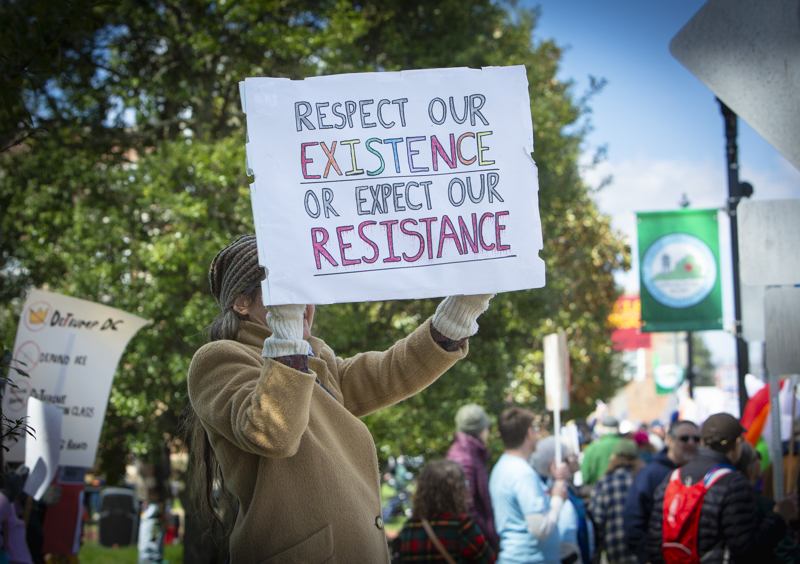
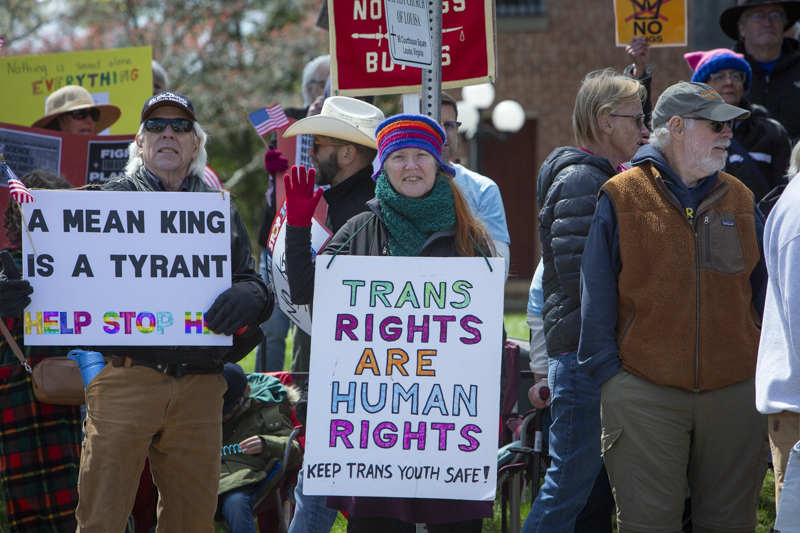
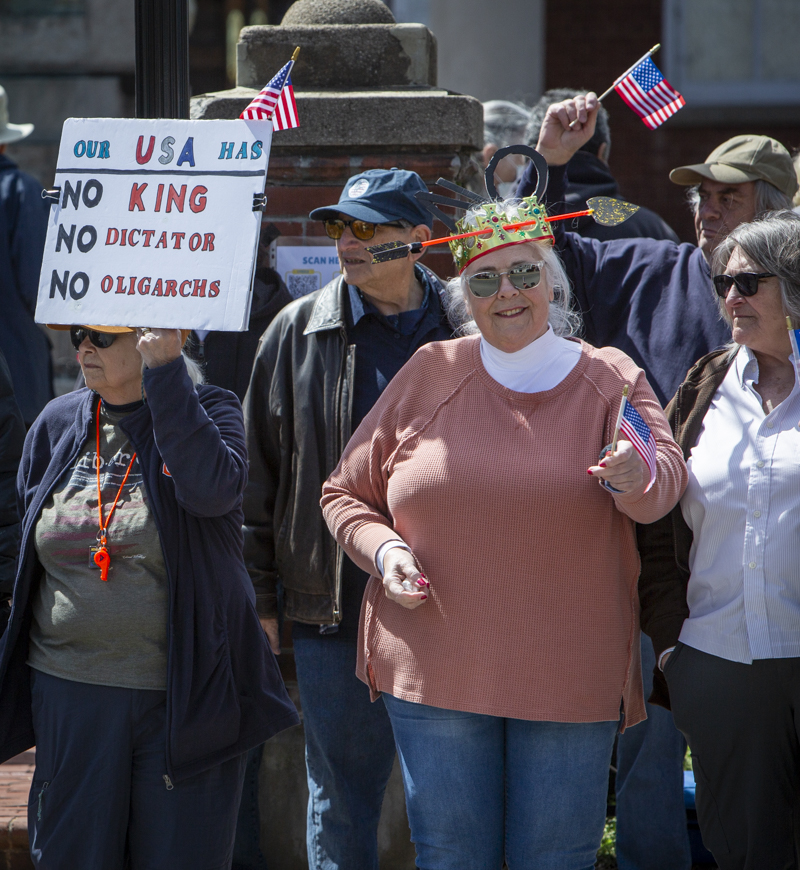
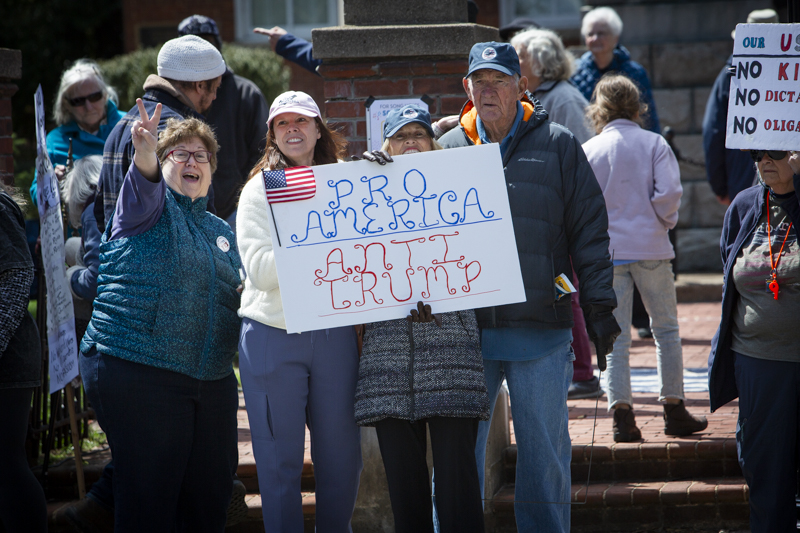
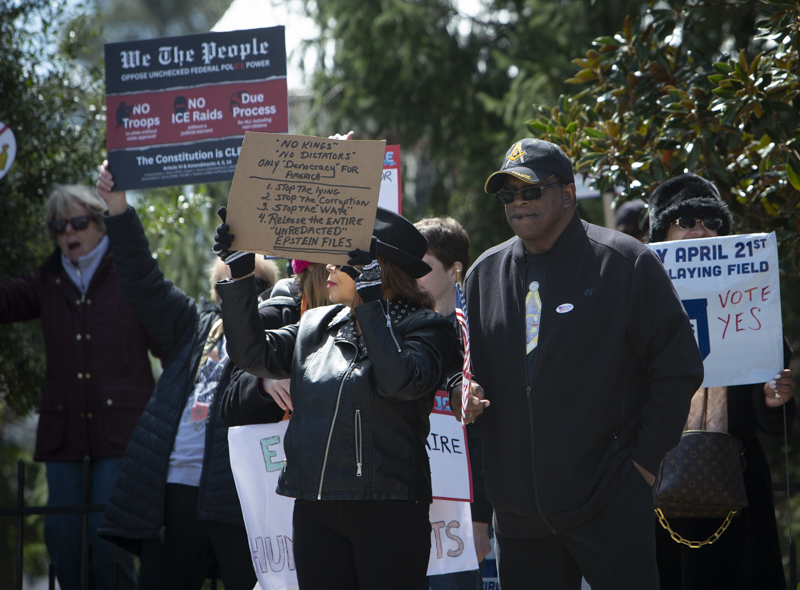
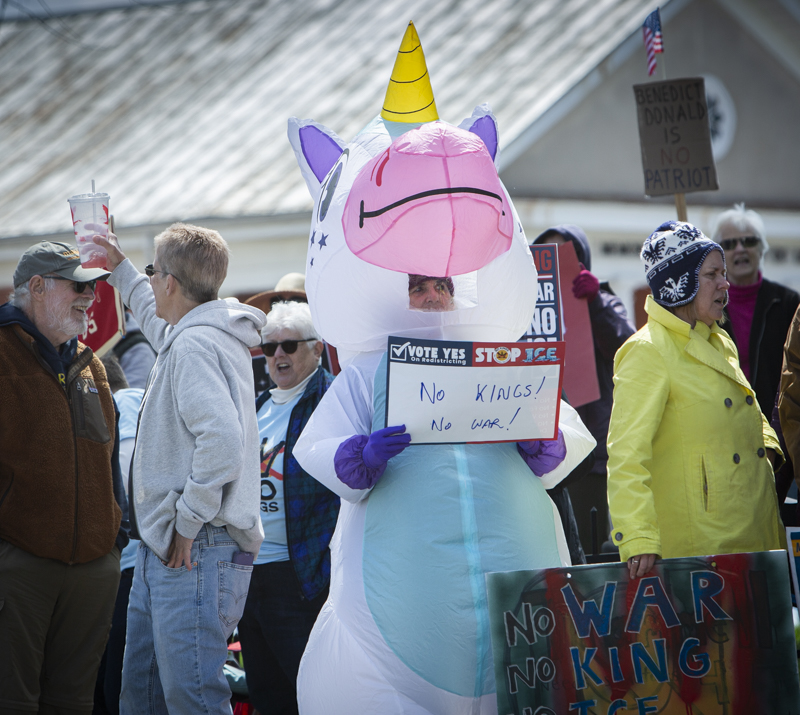
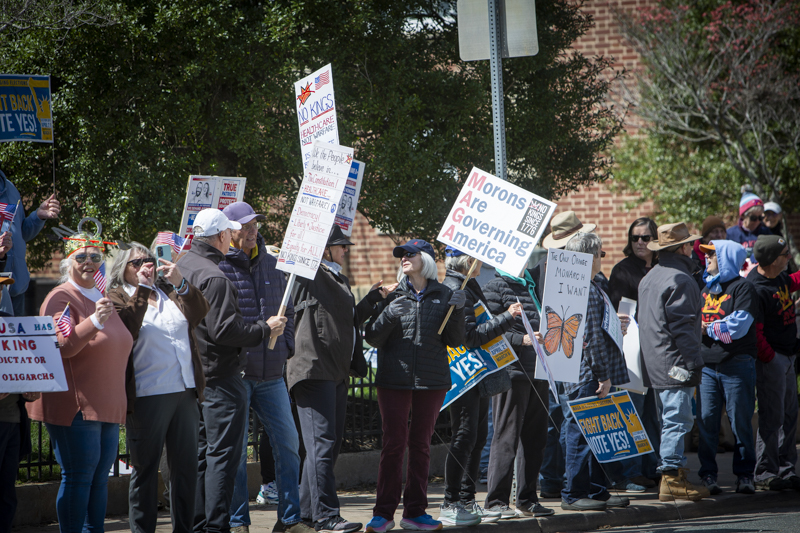
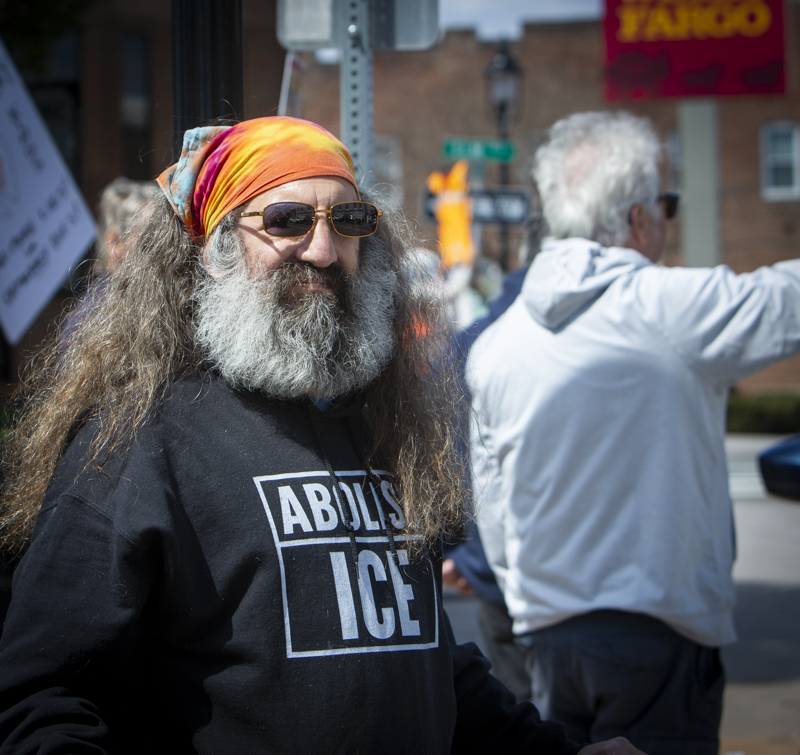
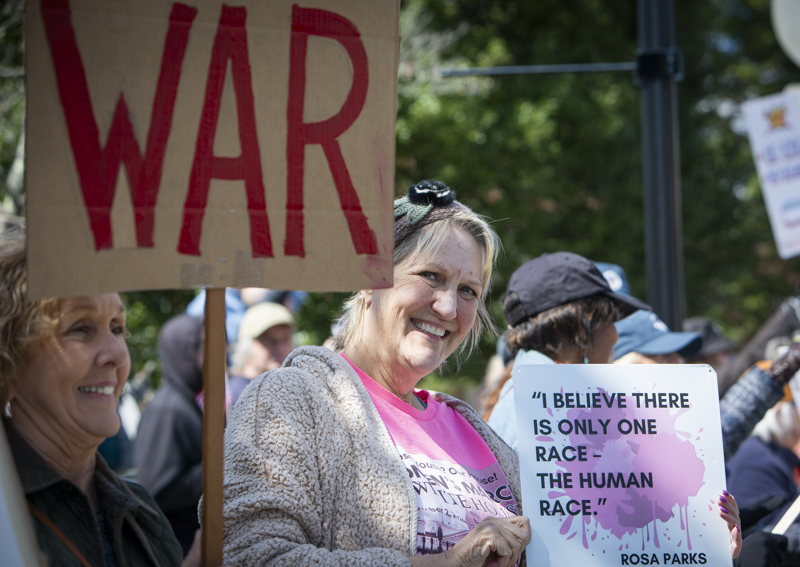
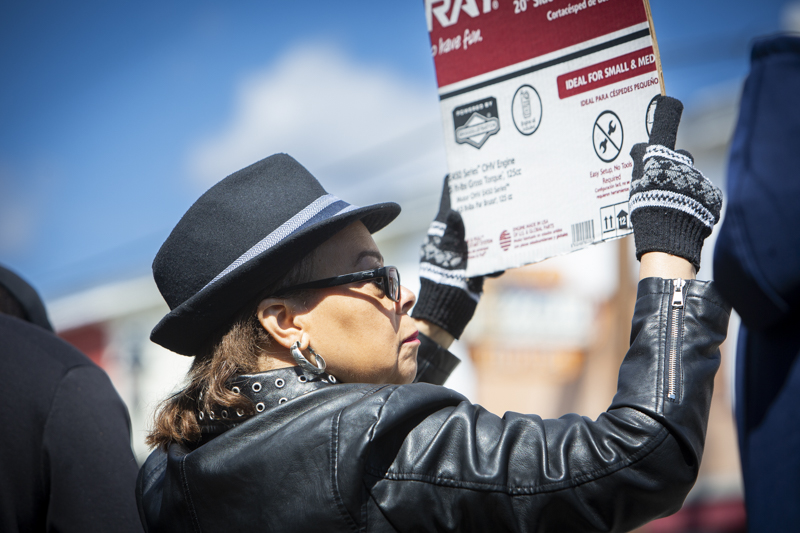
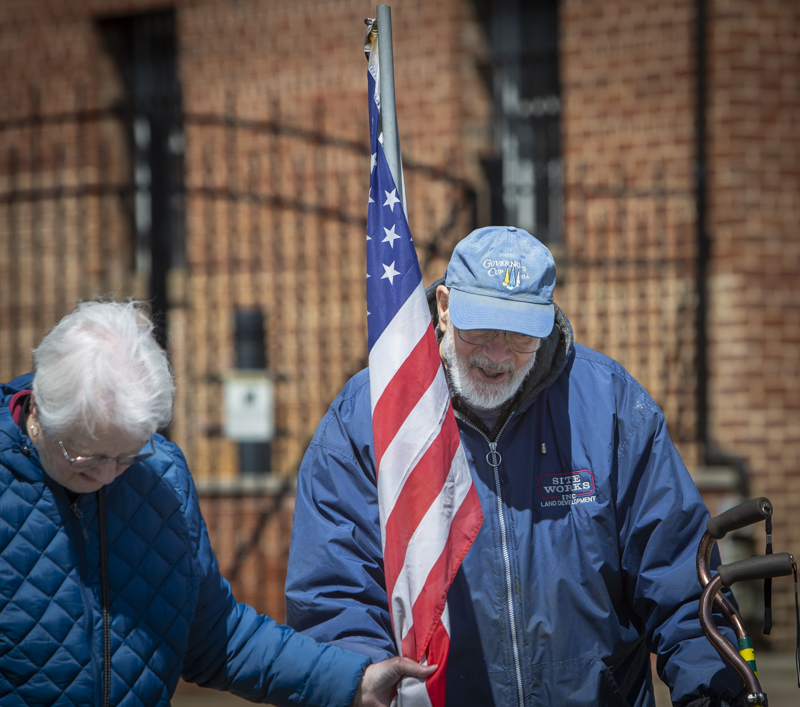
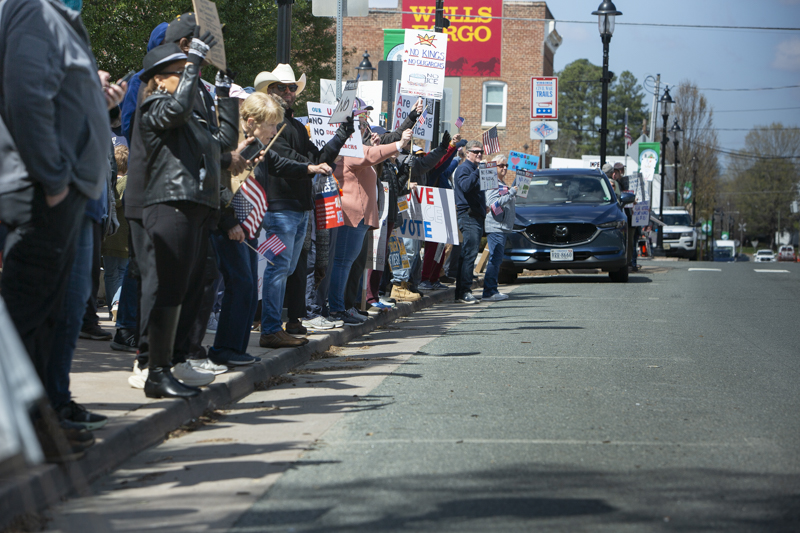
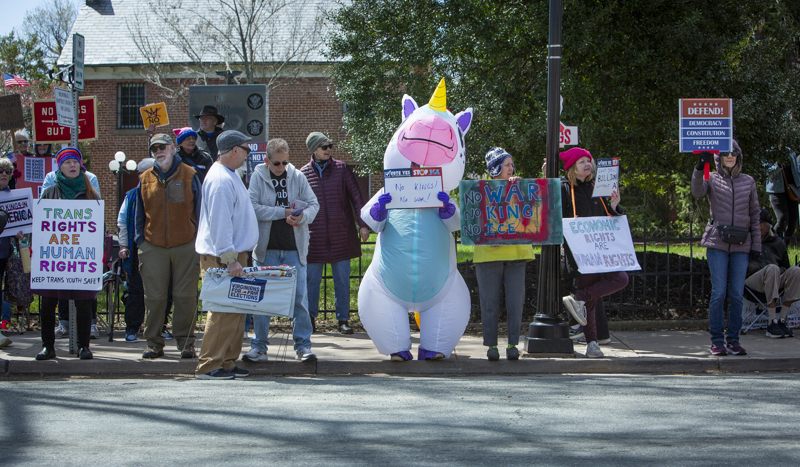
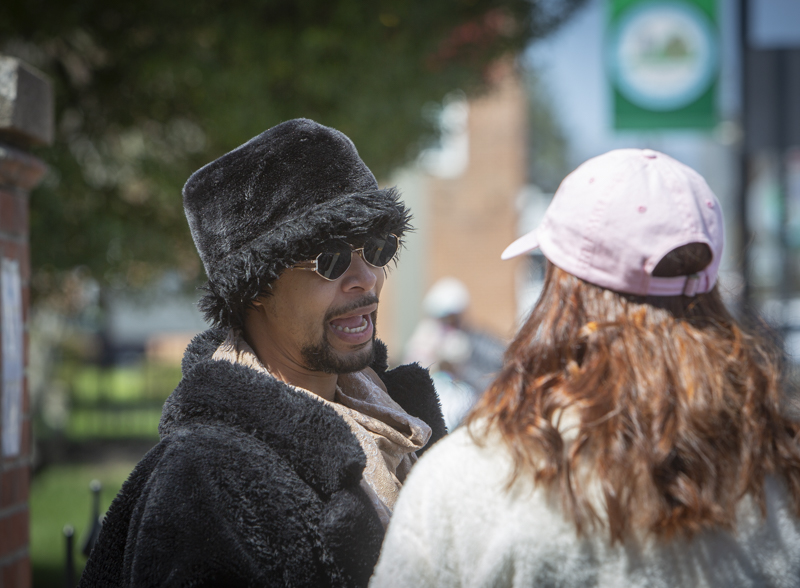
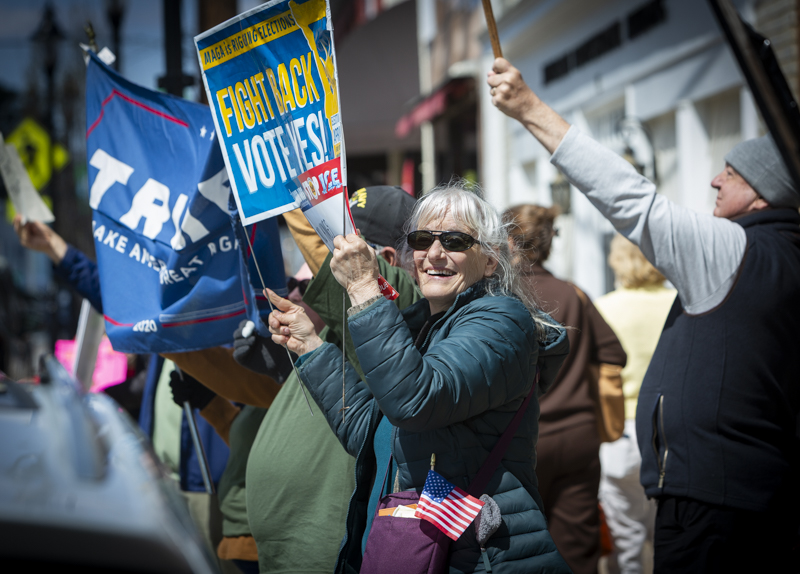
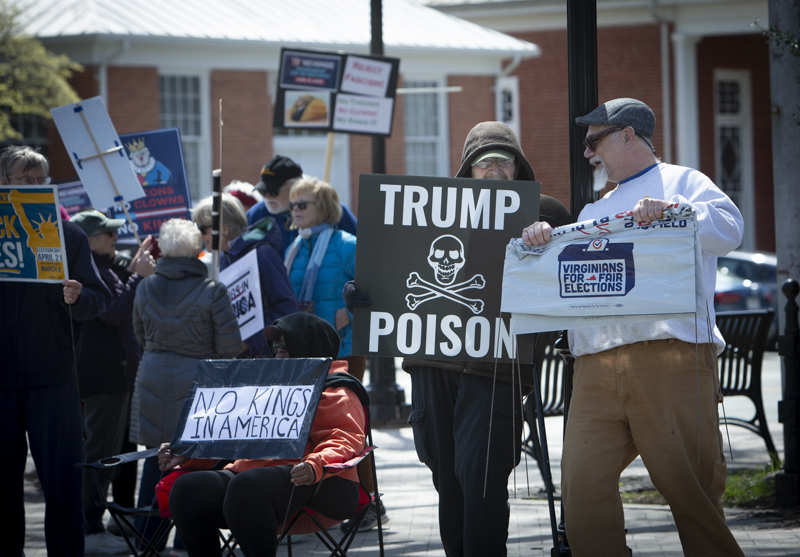
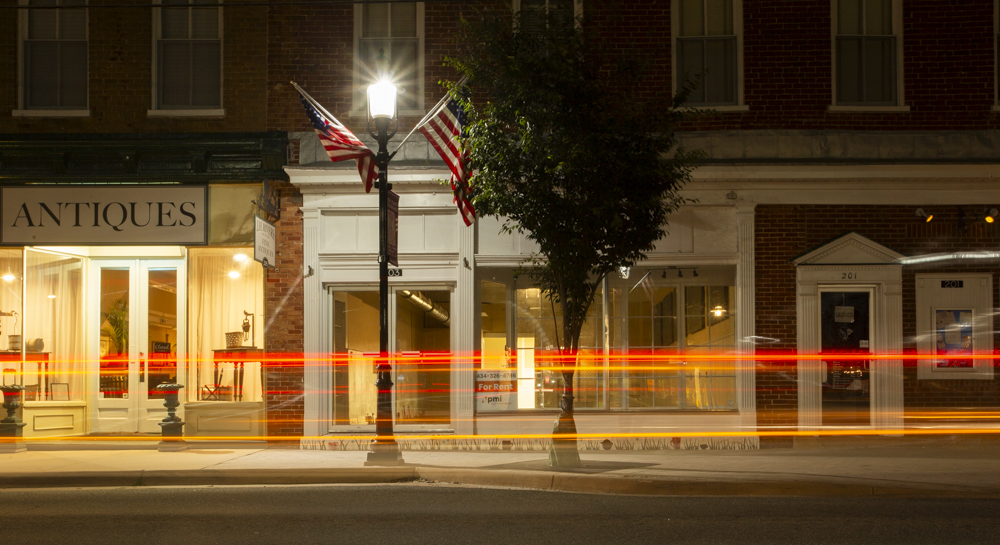
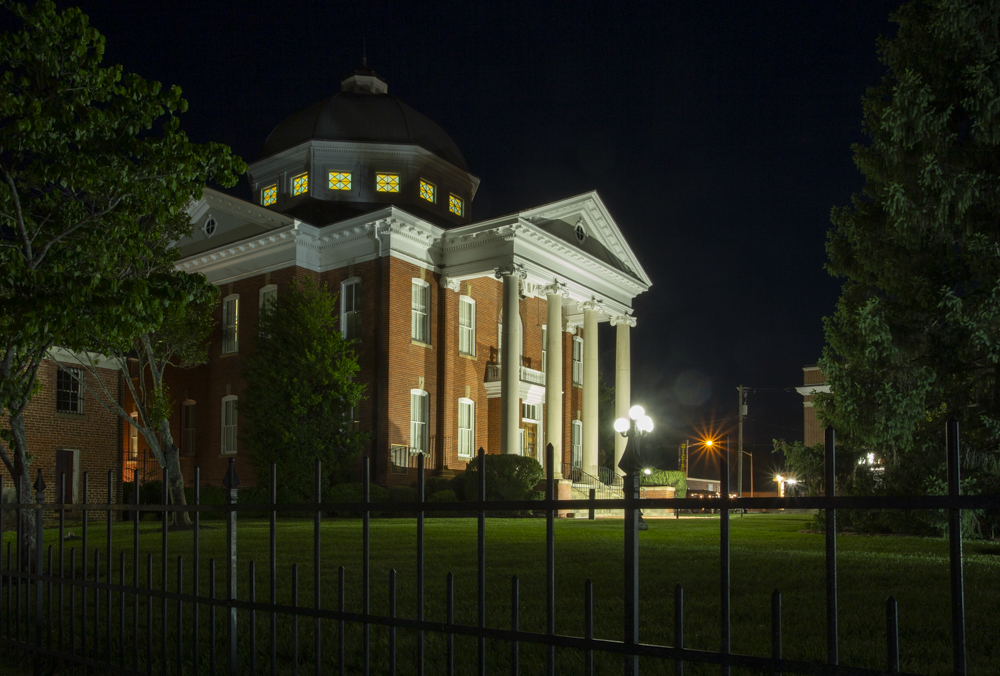
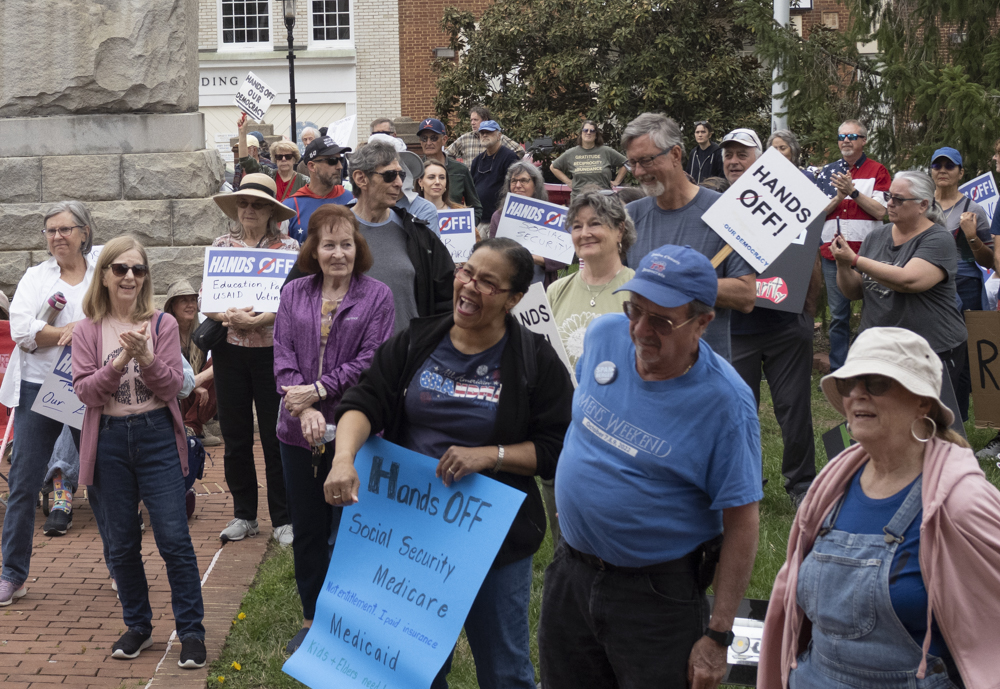
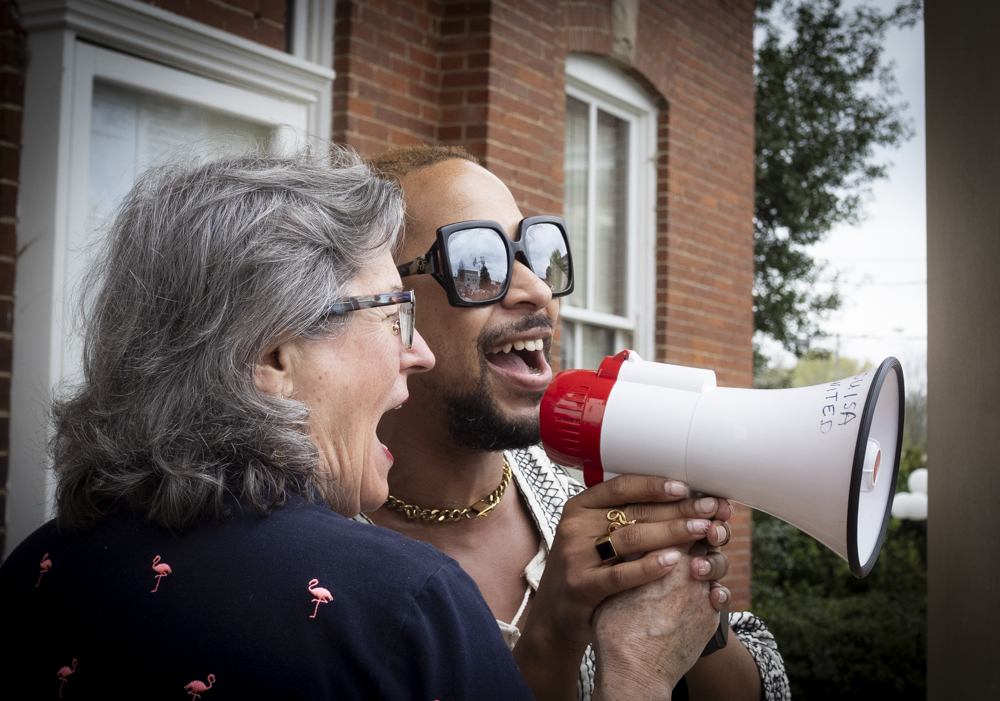
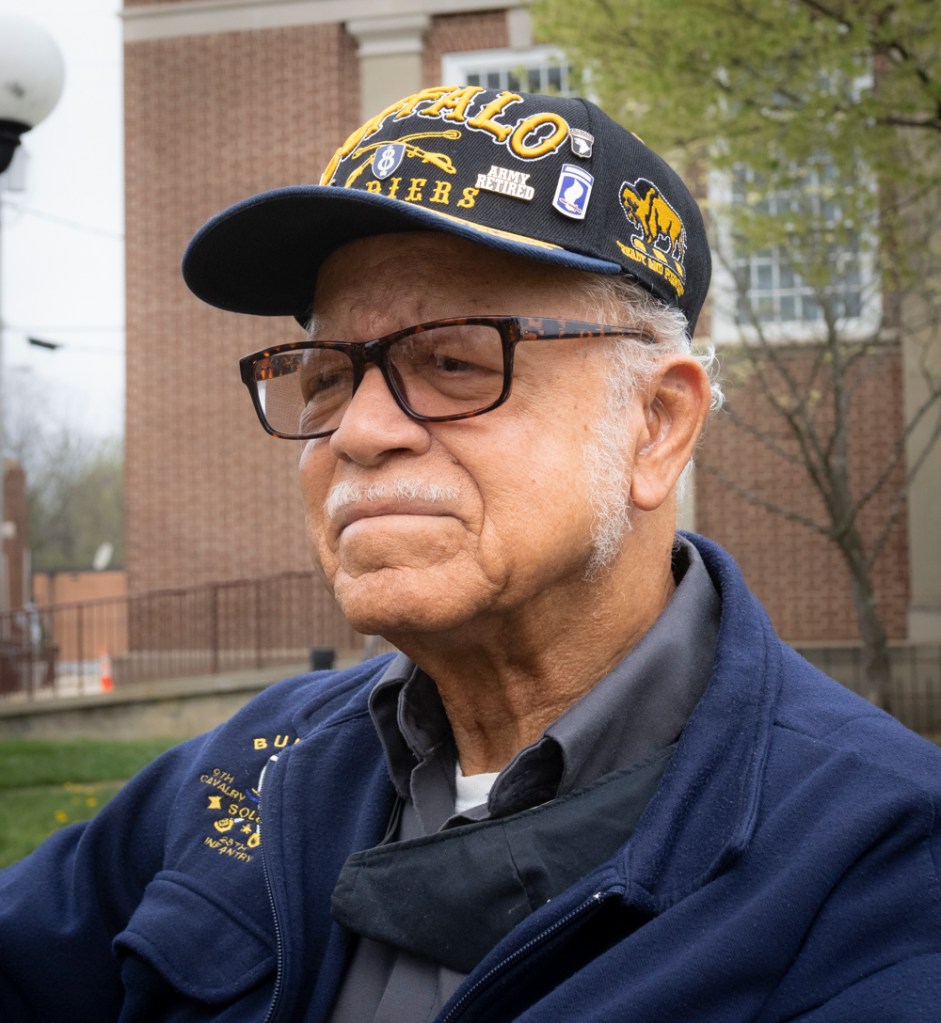
Small town America. Louisa residents rallied at the county courthouse April 28, 2026. A good showing in a deeply red rural county on a crisp spring day. A spirited and exuberant assembly of the young, the old, veterans, …. A diversity of voices. There were two Trump counterprotestors, one of whom loudly claimed that Trump was “his King.”
Virginias farmers are once again being sacrificed on Trump’s altar of stupidity and foolishness. His Noble Great Mightiness’s war has already cost the lives of thousands in the Middle East, 13 of which are American service men and women. In treasure every week, the war costs American taxpayers tens of billions of dollars. Americans are also paying at the gas pumps and in grocery stores. The defense department just presented a $200 billion reapers bill to Congress.
Virginia’s farmers will pay additional costs as well. Not only in the rising costs of fuel and fertilizer but in sons and daughters. Rural Americans are overrepresented in our armed forces. Close to 45 percent of those in uniform come from counties like Louisa.
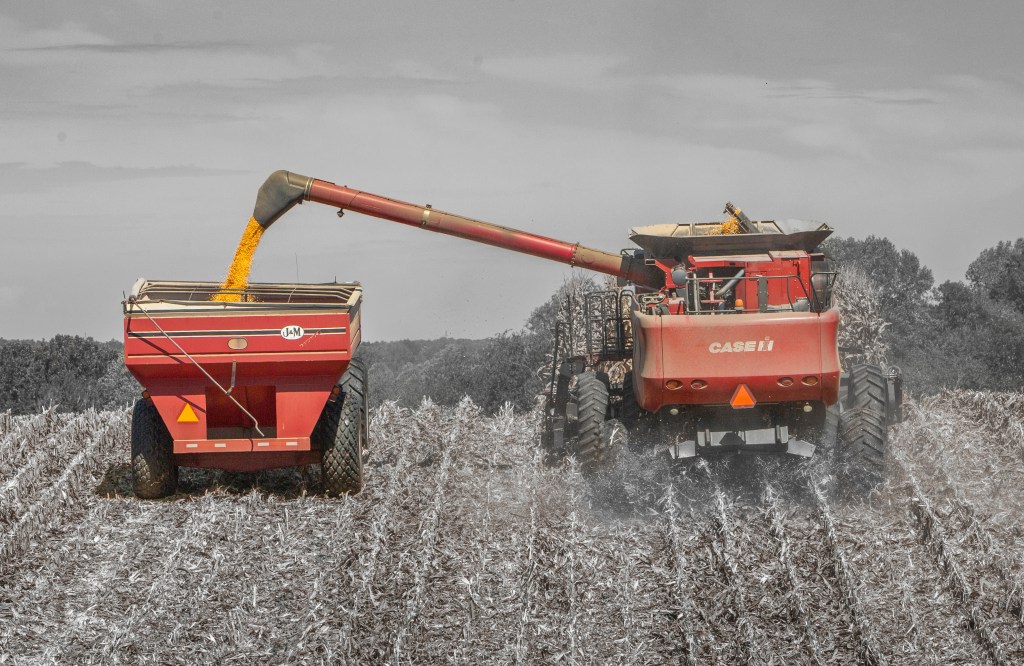
Didn’t Trump know it’s planting season. Virginia farmers must decide what to plant this year. Corn or soy or both. Decisions about spending capital on new equipment must be made as well. The soil must be tilled, the land prepped for seed. Yet, uncertainty abounds because of the war. The confused and contradictory messages coming from the administration are unhelpful as to the war’s objectives, and most importantly, its end point. The feeds the uncertainty for farmers across Virginia and the nation. It seems that while Iran is losing the war militarily, it is winning the war politically, strategically. Hope and hubris are not war plans.
While this administration postures and dithers and twirls about like whirling dervishers, the supply of nitrates for fertilizer remains plugged up in the Persian Gulf, unable to make the passage through the Strait of Hormuz, that strategic strait of water on Iran’s southern shores. Fertilizer prices have jumped as a result, on average about 20 percent. It will take months to fix the fertilizer supply chain disruption caused by Trump’s chaotic war.
Even if the war should end today, perhaps it’s too late for the farmers who need to make purchases now, or bet wrong earlier. Soy doesn’t need nitrated based fertilizers, corn does. Farmers may not take the risk of planting corn and go with soy instead. That, however, will create a surplus of soy, thus lowering the price per bushel. Can’t win either way.
That’s not all, because of this questionable war of choice, Trump cancelled his state visit with Xi of China. China is the largest importer of soy in the world and last year not one American grown soybean was bought by China in retaliation for Trump’s punitive, and in some instances illegal, tariffs. Virginia farmers lost tens if not hundreds of millions of dollars in exports because of Trump’s actions. Virginia exports over a billion dollars’ worth of farm products to China. Not anymore. The announcement of the cancelled meeting caused the price of soy to drop.
It’s pain at the gas pumps. We’ve all been to the gas station and noted the rise of gas and diesel prices. Not fun paying $3.99 a gallon for gas and over $5 for diesel. They won’t be going down anytime soon. Not with the Strait of Hormuz closed for the indefinite future and Trump threatening to put boots on Iranian ground.
I did some research on what it cost in gas or diesel to plant and grow corn and soy, from seed to market. Purdue University has some pretty good charts and tables that show the costs at each step of farming those crops. There are at least 14 phases, I learned, taken in sequence to prepare the ground, plant the seeds, weed the fields, harvest the crops, and get them to market. Most require tractors or combines or other farm vehicles.
Basically, according to these Purdue University tables, to plant 300 acres or corn and 300 acres of soy, a farmer would use approximately 3655 gallons of fuel. Broken down per acre, that would be $5.94 gallons per acre. Of course there are variables like soil conditions, age of equipment, etc, that determine individual costs. Diesel now cost about $5.59 per gallon (I didn’t deduct the taxes farmers are exempted from). That comes out to almost $20,000 in diesel costs. In prewar prices, it comes out to almost $13,000. That’s a seven-thousand-dollar war tax on Virginia farmers. Yes, it is a war tax.
Did not Trump, his Noble Great Mightiness, this genius of all things, not see this coming? And his equally impressive “We negotiate with bombs” Secretary of War, did he not see the potential consequences of the closure of the Strait of Hormuz? Fools, the lot of them.
Because of Trump’s strategic failures, Virginia’s farmers are left with footing the bill for higher fertilizer costs, collapsing soy markets, and staggeringly high fuel costs at a critical time in the planting season.
How long can Virginia’s farmers survive with this type of love from Trump? Blind obedience he demands. ‘Suck it up,’ he says; ‘be patriotic,’ he says; ‘it’s only temporary pain,’ he says. Last year Trump authorized the payment of $30 billion in farmer bailouts because of his tariff fiasco. This year he is already demanding that Congress pass a farm bill, immediately. He’s turning farmers into bailout junkies.
Another bailout is coming, a bribe to his “Farmers for Trump” tribe. He thinks he can buy their silence and acquiescence. He’s right it appears, but some are starting to see the light, it seems. Not only is he bankrupting hard working farmers, he’s also sending many of their sons and daughters into harms way. His uber patriotic sons and daughters never deigned to serve. Hell, they wouldn’t be caught dead in uniform. Barron isn’t running down to the recruiting station. No, he was just named to the board of directors of a new company. Another Nepo baby enriching himself and missing the wars, while our kids fight the wars.
Two piles of money, one $45 million the other $50 million: What do they say about America?
The latter is the amount of money that American taxpayers are spending every day to pay for Trump’s War on Iran. A week or so after hosting his Board of Peace, the president announced his preemptive war against Iran from his lavish country estate in Florida, the same night he hosted a million dollar a plate fund raiser.
The former is the value of medical care provided to Virginians by Remote Area Medicine over the years. This includes 30,000 glasses, 56,000 tooth extractions, 38,000 filing, thousands of exams, mammograms, and hearing aids.
While Trump offers to send a hospital ship to Greenland, ostensibly because, he says, he understands their medical care is not very good. Meanwhile, rural American healthcare languishes and degrades under Trump. This month Remote Area Medicine will offer a clinic in Fisherville, Virginia. That’s an hour and a half from Louisa, and where about 21 percent of folks in that Shenandoah congressional district are on Medicaid. Additional Remote Area Medical clinics in Virginia are also scheduled for Emporia (April), Luray (September), and Grundy (October). Welcome to Trump’s Golden Age.
This past September, following the passing of the Big Beautiful Bill, the Augusta Medical Group, which provides medical clinics in the Shenandoah Valley, announced the closure of three rural clinics: One urgent care and two primary care clinics. They blamed the closings and consolidation of services on Trump’s signature bill.
Trump’s promised golden era was supposed to be one with prosperity, no foreign wars, no regime changes. He is failing. On the other hand, he and his Epstein Class are living in a golden era. Trump has lined his pockets with gold and literally lined the White House walls with gold, putting his name on anything that can’t move. Meanwhile, everyday Americans suffer through stubborn inflations (it just grew again), unaffordable housing, low wage growth, and shrinking job opportunities.
He is detached from the suffering he has caused in America in general, and the carnage he is causing by his illegal and unjust war against Iran. He callously characterized the death of American servicemen as, “that’s the way things are.” As a reminder, he has a history of calling those who died in the service of our country “suckers.”
To hone this point about Trump’s disinterest, the other day when giving remarks at a Medal of Honor award ceremony, of all things, Trump drifted off point and began talking about the golden drapes behind him, saving money, and the magnificent ball room he is building. All about him as is his usual style. Americans and Iranians are dying, and he talks about is himself and the golden drapes?
Americans in November have an opportunity to change the trajectory of this country. Make our own regime change. A change of power in Congress is just the start, however. We can’t just pat ourselves on the back and say America is back. Our reputation is destroyed. No one trusts us, no one likes us, no one wishes us well, no one will come to our aid. We are the axis of evil.
Yet, we see the work of Remote Area Medicine, and if you squint your eyes, you can make out that embryo of American goodness. A country that once prided itself on the rule of law, civil society, volunteerism, fairness, and justice. We can reclaim that title, but we need to roll up our sleeves and do the hard work not for days, weeks, or months, but in the years and decades to follow.
Many of us recall the doomsday clock during the Cold War. It was always minutes before midnight: Nuclear Armageddon. Today there is another clock ticking away as our democracy ebbs. If midnight was the hour when democracy ends, the clock today would read 15 minutes past midnight. Yes, we have crossed that line into the shadow of autocracy. We can, however, reset that clock, but we must do it quickly and the first step is to vote.
Election day is upon us here in Virginia and we have an opportunity to reset that clock. It will be a consequential election with generational impacts for Virginians. Think of the world your child, or grandchild, or great grandchild will be born into if Trump has his way.
First and foremost, your vote will help keep Virginia from following several Republican states down the rabbit hole of one-party authoritarian rule. Texas is the architype of such a state: Texasistan.
A neo-theocratic state where women are surveilled and reduced to second class citizen. A state where race equates to citizenship; a state where people of Latino ancestry are subject to constant local, state and federal police stops and detentions for simply having a certain physical appearance, speak Spanish, and work in low wage jobs. Guilty!
Texas is a state that happily offers to deploy its national guard soldiers to occupy cities in Democratic lead states as Trump’s armed enforcers. A state where Christianity is foisted on folks’ children in public schools who worship differently or choose not to believe. Ones relationship to your god is between you and your creator and the state has no place in that relationship. We don’t want to be that kind of state, Winsome Earle-Sears does.
Second, Sears wants to turn the clock back to the 19th century regarding women’s rights. She spent her whole campaign using trans kids as political fodder, ostensible as a women’s rights issue. Meanwhile, she voted ‘no’ on a tie-breaking vote as Lt. Governor on a bill that would have given Virginia women reproductive choice rights, in particular access to contraception.
She claims to protect your daughter from supposed predators while whole heartily supporting a president found by a civil jury to have sexually assaulted a woman in a department store dressing room. And then Sears has the temerity to tell a woman that she has no right to reproductive choices or contraception, the right to choose when and how to have a family.
Third, a medical and insurance crisis is in the offing after the passage of the Republican’s “Big Beautiful Bill,” which Sears endorsed. Many Virginians will lose Medicaid coverage starting in 2027 as part of the bill’s multibillion dollar cuts to Medicaid. Three rural health clinics have already closed or plan to close because of the bills impacts.
Approximately 400k Virginians get medical insurance through the Affordable Care Act (ACA). Given the lapse in ACA insurance subsidies under the bill’s provisions, many of these Virginians will have to give up medical insurance given that premiums will double and even quadruple as subsidies for low-income folks lapse under the bill by the end of this year. Health care insurance will once again become unaffordable to average Virginians.
Spanberger has a plan. According to the Virginia Mercury, Spanberger said, “It’s essential that we be able to strengthen access to health care, improve affordability, and recognize that for so many Virginians, they’re one medical event away from really substantial ruin,” Spanberger adding. “But for so many, (health care cost) is just one more worry that keeps them up at night.” Sears on the other hand has no plan, except to support the big, beautiful bill.
Fourth, Spanberger will return our schools back to the people, and rid us of the Youngkin and Sears Orwellian thought police. Remember Governor Youngkin’s attempt to turn our schools in to Stasi-like institutions where teachers and students were under constant surveillance for utterances that contradict sacrosanct Republican notions of history. Youngkin even started an informant hotline one could call or email to report thought transgressors. Is that how we raise our children? Turning them into government snitches.
Youngkin’s education policy was a flop at best. Under his administration, standardized test scores that remained essentially the same after four years of his administration, and well below pre-pandemic scores. In short, a failure to achieve one of his top priority goals. Winsome Earle-Sears won’t do much better, I suspect, since she is an advocate for reducing public school funding in favor of private charter schools.
Fifth, Spanberger will be a voice for Virginia’s farmers who are hard hit by Trump’s self-inflicted tariff wars (see last week’s post). Virginia farmers are losing overseas markets, losing income, and being weighed down by unsustainable debt. Bail outs aren’t an answer, the preferred Republican solution. It’s the coward’s way out of not confronting Trump head on. If you are a afraid to criticize Trump, you already live in your own mental dictatorship.
Spanberger will speak truth to power, I believe. Nor cower before Trump like so many Republicans in Congress and state governments.
Sixth, Spanberger will fight for Virginian’s serving in not only our military, but our civil and foreign services as well. Our foreign and civil service Virginians are patriots and deserve much better than mass illegal firings, the constant dehumanization and criminalization, the threats and intimidation.
They, along with the men and women who serve in our armed forces, are the frontline against Trump’s extra-judicial and unconstitutional attempts to turn America into a police state, an autocracy. Congress is AWOL, the lower courts are fighting a brave rearguard action, only to be undermined repeatedly by the Supreme Court in yet another opinionless shadow docket ruling.
States are the bulwark against a tyrannical central government. It’s how our founders envisioned our federal alliance in 1787. States need to stand up to Trump and his federal maladministration. Virginia needs to be one of those states.
Things will get worse for America and Virginia under Trump in the next few weeks, months, and years. We need a strong democratic coalition in Virginia to weather the coming constitutional tempest and damage that may prove fatal to the rule of law. We must fight, and fight to win. A Spanberger win in November will set the tone for 2026 and beyond.
Let’s keep Virginia democratic and its people free: Vote.
“The love of power is natural; it is insatiable; almost constantly whetted; and never cloy’d by possession.”
Henry Saint John, 1st Viscount of Bolingbroke
This spring my wife and I planted a small rain garden. The plantings included several swamp milkweeds, the preferred plant for Monarchs to lay their eggs on. It’s Latin name is Asclepias incarnata for the serious gardeners out there. The other day, to our delight, we discovered a dozen monarch caterpillars denuding the milkweeds.
It took several days for them to consume every leaf. Fully fueled with toxic bitterness and relatively immune from predation, they slowly wandered off to other plants, leaving the bare stalks of the milkweed as testament to their presence. One by one they moved on, rambling off into the garden seeking leaves or branches to safely transform into chrysalises.
Within several days of the caterpillar migration, we spotted two bright green chrysalises hanging under leaves. A third caterpillar wasn’t quite there yet. We hope that within 14 days, given the mild weather, the caterpillars will be reborn as butterflies. A well-tended garden brings unexpected joys.
The discovery of the caterpillars reminded me of the words of Henry Saint John, that liberty is like a tender plant. He penned these words close to 300 years ago and the metaphor could not be more relevant in our time: “liberty is a tender plant which will not flourish unless the genius of the soil be proper for it; nor will any soil continue to be so long, which is not cultivated with incessant care.”
He wrote these words in the early 18th century, a time of upheaval in England: political factions vying for power in a deadly struggle. He didn’t always choose wisely, backing the Stuart’s claim to the crown and the ensuing Jacobite Rebellion, ending up in exile in France for some time. He is most famous, I think, for his essay “The Idea of a Patriot King,” arguing that a King should be above faction.
This idea of a King above faction is important in our own history. It informed how Washington, Adams, Jefferson, Madison, Monroe, and John Quincy Adams saw the presidency. A president above faction. They tried mightily to be above faction, not always successfully, however. Andrew Jackson threw the notion of a patriot president out a White House window along with the contents of a chamber pot.
Today, we are ruled by an unsound and troubled president hell bent on hyper factionalizing our country, resorting to violence and armed soldiers patrolling city streets. He has taken the notion of faction to new extremes in America, not seen since the late 1850s. This includes sending the military to occupy blue cities to show his political muscle; flaunting the rule of law; criminally investigating critics; ruling solely by dictate; musing publicly about being a dictator; rewriting our history; engaging in extrajudicial killings on the high seas off Venezuela; and setting the stage to nullify next year’s mid-term election results unfavorable to him.
Our garden of democracy needs tending. And damn quickly.
We must steadfastly feed and nourish our democracy. Stay informed in the face of daily trespassing against our liberty. Although in today’s world where most Americans get their ‘news’ through social media, ‘informed’ is perhaps obsolete. There still are reliable news sources out there. Social media is not one of them. Social media is an avalanche of computer driven feeds designed to elicit clicks, rage, and profit. Curate your news sources. Go old fashioned and read books, lots of them. The more you read, the more you realize how little you actually know about things you thought you knew a great deal about. That’s a good thing.
We must clear out the authoritarian weeds that plague our garden of democracy. We must elect leaders that reflect our values and are in tune with today’s generation and willing to fight. The continual reelection of octogenarians does the party no good.
We must go to the polls this November and elect Abigail Spanberger governor and weed out the noxious plants occupying Virginia’s governor’s mansion. We must not just elect her but elect her in a historical landslide. We don’t want to become an autocratic state like Texas or Florida.
We must seed our garden of democracy with plants that are robust and acclimated to our current political reality: An opposition party bent on one-party authoritarian rule. We can do that by supporting new faces and ideas in the Democratic party at all levels. Starting with David Rogers who is running for the Mineral seat in our local board of supervisors.
We must amend the soil of our garden. Get friends and family to register to vote, get them to the polls on election days. Attend rallies or local meetings. Donate to candidates you support. If you can, canvas for that candidate. Volunteer with the Louisa Democrats.
We must not only resist the orange piped piper of Mar-a-Lago but fight him at every junction. Write or call your representatives, write the Supreme Court Justices, write our governor. Tell them your story and how you are impacted by Trump’s dangerous and illegal actions. That food, housing, and healthcare will be unaffordable and unattainable once the full impact of Trump’s tariffs, deportation of farm and food processing workers, and regressive taxes are felt.
Plant a garden an act of subversion against Trump’s war on climate science. Whether you have only a south facing front door stoop, a small balcony, or quarter acre, or ten acres, plant a garden in the dirt or in pots. Every plant you grow feeds or houses an insect or animal and soaks up carbon. Get radical and grow a victory garden.
Our garden of democracy is in big trouble, but with our incessant care and nourishment our democracy can flourish once again. Together we must tend the garden of democracy and create the space and time to protect and nurture liberty’s chrysalis from Trump’s insatiable drive to possess absolute power.
This essay started with a conversation my wife and I had while on our way to Fredericksburg. Of all things, it was about why Postal Service mail trucks needed to be redesigned. Grumman Long life Vehicles, apparently that’s their official designation, were designed well before the age of Amazon.
Whenever the mail truck in our neighborhood passes by, it seems overflowing with boxes large and small, like an overstuffed sandwich. Eventually it sparked questions, questions we could not answer, like when did home mail delivery began. We’ve all heard of the pony express and that Ben Franklin as the first Postmaster General, but what about the nuts and bolts – the who, what, when, and where –of getting mail to our mailboxes. Why do mailboxes look like they do — black and cylindrical for the most part — and why are mail drop boxes blue?
Very rural Louisa got its first post office in 1800. It was in a tavern and Inn owned by John Jouette, who in 1781 became Virginia’s Paul Revere when he rode 40 miles to warn members of the Virginia General Assembly and Governor Thomas Jefferson that a British raiding party was on its way to Charlottesville. In many instances in early America, taverns and inns served as focal points for local government business and ‘court days’ when circuit judges (hence the term circuit courts) came to town. It was also a time of drunken revelry it seems. Local militias also meet to drill on these dates. Hard cider, rum, whiskey, and politics, what could go wrong? The Louisa Courthouse, built on, over, or around the Tavern, served also as the post office later. This according to the town’s official history.
Free home delivery in urban areas began in the mid-1850s. It was not until 1896, however, that free rural delivery began. It had a fitful start in 1892, when Congress balked at the six-million-dollar price tag. Quite a sum in those days. In 1893, Congress appropriated $10,000 to “experiment” with rural delivery routes. The new Postmaster General, however, refused to act. Additional monies were appropriated by Congress for free delivery route experiments, but it was not until 1896 that Postmaster General William Wilson began experimental free rural delivery routes in his home state West Virginia. It was a success and spread rapidly to other states.
So successful that “free” was dropped in 1906. RFD as it was called, began in Louisa County on October 1, 1903. Yep, the postal service has a specific date for Louisa. The mail was delivered via horse and wagon for the most part and I wonder how many horses were employed in such tasks. According to one estimate, by 1906 there were about 700,000 miles of rural routes. The mail carriers also sold stamps, money orders, and registered mail. They were, according to the postal service, essentially “travelling post offices.”
What struck me about the history of free rural delivery is its progressive roots. Postmaster General John Wanamaker (1889-1893) when he proposed free rural mail routes in 1891 spoke about populist movements – such as the Farmers Alliance — that demanded mail delivery in rural areas: “I think the growth of the Farmer’s Alliance movement and other farmers’ movements in the past few years has been due to his hunger for something social as much as anything else.”
Wanamaker’s statement was an understatement. The Farmer’s Alliance and other farmers’ movements were very active politically and had been since the 1870s or so. They even ran a candidate for President in the 1890s following the Depression of 1893, the worst economic calamity the U.S. faced before the Great Depression. Their party platform included such things as free rural routes, government regulation of railroads and telegraph companies, silver as legal currency in addition to gold, rural electrification, income tax vice tariffs, low-interest government backed loans for farmers.
It never occurred to me that the free rural delivery was a result of late 19th century populist progressive politics. While the Farmer’s Alliance fractured and faded — as someone once said, third parties “are like bees, they sting once and then die,” their ideas did not. Many propositions on the platform were adopted by reform minded progressives of the early 20th century and became law. For instance, the Progressive Party Platform in 1912 called for the ‘extension of rural delivery routes,’ which resulted In1916 “Rural Post ‘Goods’ Road Act,” provided federal funds for rural post roads. Many of the roads we travel today in Louisa had their origins then. Additionally, legislation to create federal loan subsidies was also part of this progressive legislative spree in the early 20th century.
Now that ‘progressive’ has become a pejorative in conservative circles, for those farmers and denizens of rural America who want to Make America Great Again and eschew progressive ideals and legislation, go get your chain saw and cut down your progressive socialist mailbox. And stop driving on all those damn progressive rural mail roads.
What awaits rural Virginians now that the big, beautiful bill is now law? Now comes the hard part for vulnerable rural Virginians with limited incomes as safety net programs such as Medicaid, SNAP, and Medicare benefits shrink or disappear. This is compounded by cuts in programs that provide meals to school age children whose families can’t afford to pack school lunches much less pay for the ones provided at school. Even the anti-immigrant sentiment will have long term impacts to America’s healthcare system. There is a tsunami of despair that will sweep rural America, compounding existing systemic troubles accessing timely health care for millions of un- or under insured Americans.
During the COVID epidemic my source for this essay – my wife – volunteered with the Remote Area Medical Volunteer Corp, a non-profit that provides dental, medical, and vision care at pop-up clinics across the U.S. (RAMUSA.org). RAM was founded in 1985 with the mission to provide mobile clinics at remote locations outside the U.S. It later began organizing these pop-up clinics to fill a need for underserved Americans that live in healthcare deserts.
The mobile clinics that my wife volunteered at were in Southwest Virginia. She provided logistical support to the medical teams, such as registering patients. Her stories are both sad and harrowing, they’re about folks that serve their communities, and the fortitude of the communities they serve.
At a typical pop-up clinic, the patients arrive at mid-night when they arrive at the designated facility’s grounds, such as a county fairground. They are given a numbered ticket and asked to stay in the designated parking area overnight. It is first-come-first-served, and the tickets go fast. The number of tickets is based on the number of volunteer doctors, dentists, nurses, other clinicians, and administrative folks. The administrative task of registering patients begins first around 6 the next morning.
At the mobile clinics where she volunteered, the patients represented a wide spectrum of ages and life experiences, according to my wife, but mostly 50 and up, with young adults being the second largest group. She recalled one young family — a woman and her three kids ages from 4 to 13. They came for dental care but were quickly referred to the medical clinic. The youngest shaking uncontrollably. He hadn’t eaten breakfast and when he had his last meal was anyone’s guess. At the medical conex, the crew scrambled to get breakfast for the kids and started to gather care kits: toothbrushes, toothpaste, soap, combs, shampoo. Their home had no running water it was learned.
For many these mobile clinics are the only healthcare they get. The services include eye exams, and if needed glasses donated by the Lions Club; hearing tests, and if necessary, hearing aids donated by a local audiologist; dental care is provided by dentists and student volunteers from dental colleges; prescriptions (one course) and follow up care scheduling; mammograms provided in a mobile RV provided by a non-profit hospital system.
My wife noted that many of the medical students assisting the doctors were from South Asia and the Middle East. That is international students attending American medical universities. More on that later.
Most patients were on or had gone off the financial precipice: Little to no health care insurance. Per RAM, 50 percent of their patients have no health insurance. It’s much worse for vision and dental insurance coverage. There were elderly on Medicare seeking care. They could pay their premiums but could not afford the co-pays for doctor visits. Because the payment assistance program for Medicare premiums was severely cut in the big, beautiful bill, those that could not even afford co-pays will most likely loose complete access to Medicare health insurance.
Another lifeline for these folks is Rural Health Clinics. Medicare Part B and Medicaid payments subsidize these clinics, but billions in cuts will mean many of these rural health clinics, to include the one in Louisa, may close, worsening the crisis in rural health care.
As context, the federal government’s first foray into healthcare came in 1946 with the Hospital Survey and Construction Act. By 1981 there were 3000 new healthcare facilities and an additional 6600 beds. 60 percent of those beds were in communities of less than 25,000. Medicaid and Medicare were created in 1965 followed by the Rural Health Clinic Services Act of 1977. These were all bipartisan Acts; however, the zenith of rural healthcare seems to have passed long ago. The partisan big, beautiful bill guts a neglected and crumbling rural healthcare infrastructure, eventually millions will be without timely adequate healthcare. And for what, $40 billion in migrant concentration camps and a trillion-dollar defense bill, 10,000 more ICE agents, and $3.4 trillion in tax breaks to the top 10 percent?
Profit driven hospital systems and insurers will not fill the gap. No profit in it for them. Sad because of the top 20 hospital systems all but one reported net revenue gains. The top company measured in total revenue – Kaiser Permanente — reported a whooping 15 percent increase in 2024. Some smaller companies reported even greater increases. Net revenue from patients also grew, according to Hospistalogy.com. Interestingly, the National Association of Insurance Commissioners, reported a 14 percent decline in net income for health insurers in the first half of 2024. On a side bar, the NAIC statistics showed that claims per month per member for Medicaid and private insurance was about the same for Individual, Group, and Medicaid: $408, $482, $481 respectively. Medicare claims per member per month was $1146, almost triple. But that is to be expected from an older age group.
Another threat to America’s healthcare system in general, and for rural America in particular, is the availability of healthcare providers. According to the Association of American Medical Colleges, about 1 in 5 physicians are foreign born. I have read other sources that indicate 25 to 26 percent of doctors in the U.S. are from abroad.
Importantly, these foreign born and trained doctors are more likely to serve in areas with greater poverty, according to the American Immigration Council. The Council further stated that areas with a 30 percent poverty rate, one-third of the doctors are foreign trained. A University of California San Diego Website reported that while 20 percent of Americans live in rural areas, only 11 percent of US doctors work in these areas, and that foreign born and trained physicians fill the shortfalls. It’s not just physicians. About 15 percent of nurses in America are foreign born and trained.
The current administration’s anti-immigrant fervor against migrants, whether legal, undocumented, or adjusting status, is sending chills across the globe I would think. Many are asking (I know I would), “do I want to come to America where I am unwanted, hated, potentially abused and imprisoned because of the color of my skin and accent?” Travel bans, blanket visa denials and revocations, potential arrest and deportation for engaging in free speech on campus, all will drive away potential medical students and foreign-born healthcare providers. Imagine the impact if America lost 15 or 20 percent of its healthcare providers? The MAGA Ebenezer Scrooges in Congress would respond, “What, are there no funeral homes and casket makers?”
While the number of international students at American medical schools is less than 2 percent, I imagine those numbers will drop significantly. With a shortfall of 45 to 50K doctors, America is already in a healthcare crisis mode, further reducing the flow of healthcare professionals to the U.S. will only hurt the most vulnerable.
No money, no clinics, and no doctors is what awaits rural America. Don’t buy the bit about Medicaid scofflaws or Medicare cheaters being the problem, this is about wealth and greed, income inequality and regressive Republican tax policies. It may take a year or two for the tsunami to reach the shores of rural America, but it is coming. If you don’t believe me, volunteer at RAMUSA.org. They have clinics looking for volunteers.
For three plus years my wife and I were volunteer repair program managers for Charlottesville’s Habitat for Humanity program in Louisa. The repair program primarily focused on ensuring folks could safely get in and out of their homes. This included repairing or replacing decks or stoops and stairs, replacing or repairing exterior doors, installing ramps. We also replaced or fixed window, siding, soffits, gutters, and the occasional roof. The work was all done by volunteers. One year I put 2500 miles on my truck supporting Habitat projects, which reflects the demand for housing aid in Louisa County.
Whether or not a project went forward after the initial survey and scope of work was completed, depended on the client’s income. They had to make at or less than 50 percent of the average marginal income for the county. Our typical client was female, over 65, widowed, earning between $8 to $24K per year. The bulk of that from Social Security. To say the least, they struggled to keep maintain their homes. Most had worked their entire adult lives yet have economically drifted downwards into poverty once they can work no longer.
No defined pensions, marginal savings if any. The only wealth they have was tied up in their home and land, but without being able to maintain the home or land, its value shrinks. Given the absence of affordable housing in the county, the elderly who want to maintain their independence and local connections have two basic choices: Sell and move out of the county or stay in a decaying home. The Fluvanna-Louisa Housing Foundation is working solutions for this conundrum of Louisa’s elderly, pulling an indifferent Board of Supervisors along with it.
The reasons for the statistic regarding our primary clients are myriad, but three primary causes stand out. Women tend to get paid less than their male counterparts, even if they worked the same job. This continues to this day. Additionally, women of the generation we tended to work with were limited to careers they could work in, which in many instances, were lower paid. Finally, during childbearing years, women usually had to quit work or take long periods of unpaid leave. A triple whammy. Social Security benefits are tied to one’s annual income and lifelong earnings. So, after decades of work and sacrifices, women tend to have accumulated less Social Security benefits and retirement savings. Their reward? Poverty.
The ‘big, beautiful bill’ will add misery to the county, especially to our elderly on fixed limited incomes. For instance, our elderly clients typically pay Medicare premiums out of their Social Security benefits. For those that cannot afford Medicare premiums, which I imagine were most of them, there used to be financial assistance through the Medicare Savings Program (MSP). The beautiful bill cuts or eliminates assistance. The MSP cuts could force enrollees who earn less than $24K a year to pay an additional $3000 out of pocket for Medicare premiums, potentially $8k if a couple. Our average client will be devastated economically, to say nothing about the impacts to their health care should they lose Medicare insurance, such as access to prescriptions.
Speaking of health care, cuts to Medicaid will indirectly impact access to health care for the elderly in rural areas such as Louisa. Rural hospitals and clinics rely on Medicaid payments to stay in business. Less income will result in closures. About 17 percent of Louisa residents rely on Medicaid. Louisa is already a medical care desert as it is, and it will get worse after this bill. No hospital, no public health clinics (except for Central Virginia Health Services, a non-profit group), and no private urgent care type facilities (not profitable enough for them to come to Louisa). I imagine that the number of doctor offices we do have will shrink.
Shifting money to the wealthy. The bill does provide for a senior tax deduction. If you earn more in income benefits, you can claim a larger tax deduction. For instance, if you are 65 or older, earn up to $75K, these folks can claim a $6500 tax deduction. Our typical client would not benefit from this tax deduction at all.
This senior tax deduction is another way of transferring wealth to older, wealthier folks, and short shifting the young. Contrast the $6500 senior tax deduction with the $200 dollar increase in childcare tax deduction from $2000 to $2200 per year. I thought we loved our children. In Virginia, the average infant childcare cost is $14k per year, about $11K for a four-year-old. Overall, these types of tax breaks will accelerate the depletion of the Social Security Trust Fund. Basically, now 2033.
The bill is big, but it is not beautiful, it is damn ugly, like the spaghetti western, the good, the bad and the ugly. Mostly the latter two. It attacks the poor, marginalizes working class women, and transfers immense wealth to the upper classes, leaving many to struggle mightily for safe housing, food security, and access to health care. About 60 percent of the bill’s financial benefits will go to 20 percent of the population. 12 million folks will lose access to health care insurance. Millions of working-class folks will lose access to food aid because of “paperwork barriers” designed to reduce the number of enrollees. Yet, with these “savings” we are going to build a police state through $150 billion in increased funding for DHS agents and a trillion-dollar defense budget.
Our 5th Congressional District representative John McGuire voted for the bill and issued an ingratiating, bootlicking, suck-up press release fit for North Korea, not America, on the cusp of 250 years of independence from Kings. Like a sucker fish on a shark, McGuire is attached to Trump’s big, beautiful orange ass.
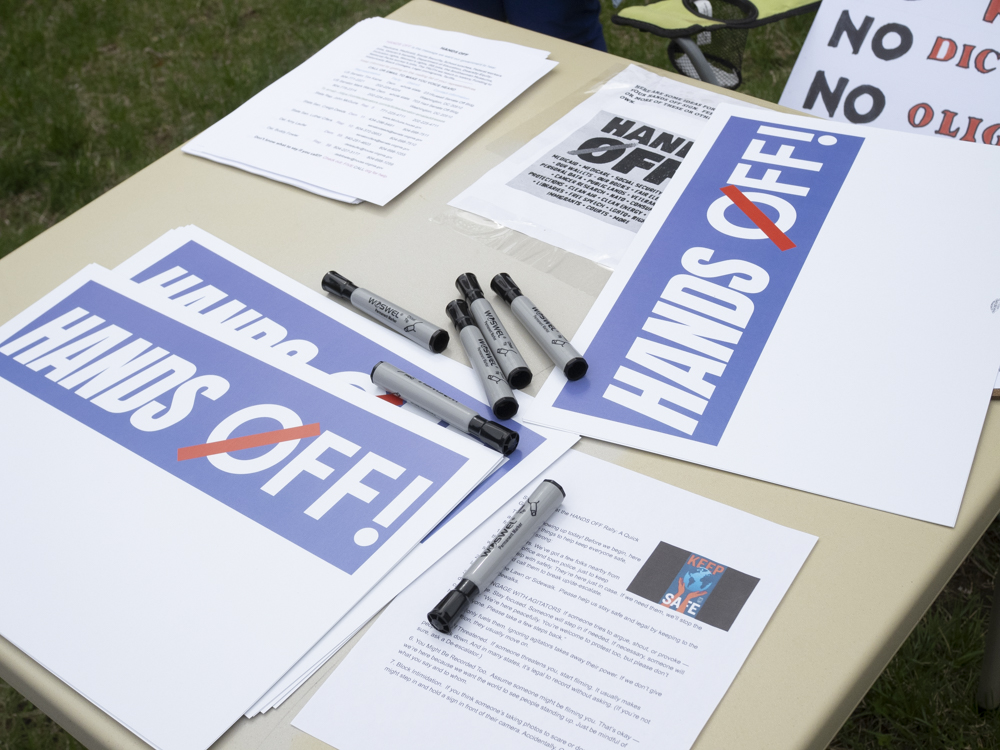
As part of nation-wide Hands Off protests and rallies, residents of Louisa, Virginia, assembled at the Court House steps this Saturday to add their voices to a growing chorus across America, and the world, excoriating Trump’s attacks on democracy.
Organized by the Louisa County Democratic Party, the rally was one of the largest gatherings, as I understand it, in memory. The diverse and enthusiastic participants focused on wide ranging issues: Constitutional rights, Education, Healthcare, Human and Civil Rights, Immigration, Justice, LGBTQ rights, Social Security, and Veteran Services. This wasn’t a one issue rally.
Boos and Jeers for Trump
Speeches, songs, and chants filled the Court Houses front steps from noon to two. Homemade signs expressed patriotism and anger. A number of speakers derided Trump’s attacks on democracy and also on our congressional district’s representative John McGuire (R) lack of honesty and integrity in the face of constituent questions.
A song or two
A Louisa Veteran
Speakers repeatedly called to protect social security, medicare, and medicaid –which assists Americas most vulnerable populations — from being cut to fund trillions in taxes cuts for the millionaire class. Boos and catcalls followed mentions of Trump’s tariffs. One speaker addressed the serious threats to veterans and their health services because of massive layoffs and program cuts at the Department of Veterans Affairs. Trump, Musk, and McGuire the villains of the day.
A number of participants volunteered to speak to the assembled crowd. One told of his still living mom’s experiences in Nazi occupied France — she was 11 when they invaded — and her fear that America is heading towards fascism. I can relate to that as my mom and her family lived under Nazis occupation as well. She sees parallels today.
Imagine driving down Fredericks Hall Road in the early hours heading to work, sipping coffee, a black suburban following too close for comfort. Minutes later a sheriff’s deputy car pulls in between you and the suburban, turns on his or her emergency lights. You pull over into the B&L Mart parking lot, the suburban following the deputy’s car into the lot.
Out jump agents in camouflage vests, long guns at the ready. They order you out of the car, pushing you to the ground, cuffing you, your body violated in every sense as they search you. Before you know it your whisked away in an unmarked van to a non-descript detention center. Your “Why am I being arrested?” protests ignored. Demands for a lawyers rebuffed. No Miranda warnings. Requests to make phone calls denied. Within hours a flight, then a prison in a foreign country.
At best this sounds like a screenplay for a cheap, low budget film. At worst, a nightmare. Unfortunately, it’s the latter. The Trump administration has used similar tactics repeatedly over several weeks. One Maryland man, who was in the U.S. on protected status, was grabbed from the streets, detained, denied due process, and ended up in an El Salvadoran maximum security prison. The government admitted later he was detained because of an “administrative error,” adding it was powerless to have him returned to the U.S. and his American wife and 5-year-old autistic child. Several other persons legally in the U.S. have also been individually detained, imprisoned, and marked for deportation without due process.
In a larger multi-state operation, hundreds of persons were detained and deported during arrests allegedly targeting Venezuelan gang members when Trump invoked the Alien Enemies Act of 1798. Despite a federal judge’s order to stop the deportations pending court hearings, even ordering the return of flights in progress, the government willfully ignored the order and let the deportations proceed apace, citing that some of the planes were over international waters and therefore beyond their jurisdiction to recall.
Newsfeeds showed the deportees led off the planes in shackles, moved from point to point by soldiers forcibly doubling them over, heads shaved for TV crew consumption. A chilling display of dehumanization reminiscent of Nazi deathcamps.
At the core of these detentions is the secretive nature of the arrests and reluctance and outright vexatious refusal to respond to federal judges’ orders to produce the body in court: The Writ of Habeas Corpus.
Habeas Corpus
Habeas Corpus’s roots go back to Anglo-Saxon times, evolving after the Norman Invasion in 1066, enshrined in the 39th clause of the Magna Carta in the 13th century, and in 1679, put into English law with the Habeas Corpus Act. The reason for the 1679 Act, from what I can gather from its text, is that Sheriffs and others were claiming not to have received or misplaced writs of Habeas Corpus, causing “great delayes” and “long detaining’s in Prison….to their great charge and vexation.” Sound familiar to Trump’s government lawyers?
You must put the 1679 Act within the 17th century’s context of the power politics between King and Parliament in England, eventually being settled as part of the Glorious Revolution of 1688/89 and the birth of the English Bill of Rights. One mustn’t lose one’s head over this history (a little pun off the top of my head), but it is worth recalling.
Americans thought it such a great idea they put it in our Constitution, not once by twice. It can only be suspended in cases of invasion or rebellion. The 1789 legislative act creating America’s judicial system gave federal judges the right to issue writs of Habeas Corpus but limited to federal matters. This power to issue Habeas Corpus writs was expanded after the Civil War in 1867, to include State detentions.
Rebellion
At the outset of the Civil War, President Lincoln suspended Habeas Corpus in certain regions in April 1861. After the arrest of Marylander John Merryman, who was spirited off to a military fort, Supreme Court Chief Justice Roger Taney (of Dred Scott infamy) — who also oversaw Maryland’s federal circuit court – issued a writ of Habeas Corpus, demanding Merryman be brought before a judge. Taney argued that only Congress can suspend Habeas Corpus, not the President. Lincoln refused.
Lincoln’s Proclamation 94, issued in 1862, further expanded the geographic scope of the suspension of Habeas Corpus. Congress debated the issue of whether the president or congress can suspend Habeas Corpus, as the Constitution is silent on this matter, but came to no definitive conclusion. In 1863, nonetheless, Congress passed an Act Suspending Habeas Corpus to give Lincoln’s acts legal cover. Lincoln signed the bill.
Alien Enemies Act 1798
Unfortunately, the Alien Enemies Act has been used to short circuit Habeas Corpus. The Act has several parts, it includes a declaration of war, or invasion or predatory incursion by a foreign nation or government. Only then can aliens of these invading nations be rounded up, or as the act states, “shall be liable to be apprehended, restrained, secured and removed as enemy aliens.” The west coast roundup of Japanese aliens and citizens of Japanese ancestry and their interment in prison camps during the Second World War is one example.
The round up of alleged Venezuelan gang members under the Alien Enemies Act is absurd. The gang is not a nation state, it is not part of an invading army or force, and a state of war between the U.S. and Venezuela does not exist. And by the way, only Congress can declare war.
The War Mindset
This recent short circuiting of Habeas Corpus reveals the mindset of Trump and his administration. They are at war with parts of America. And they are using war-time emergency powers such as the Alien Enemies Act to dilute and nullify the Constitution. Trump is on a war footing where no war exists, and Americans need to take notice. If you think he will stop at non-citizens or legal permanent residents, I would think long and hard about that proposition. Just as insidious are those lining up to inform on folks. Are we heading to a police state?
Think about our neighbors. Migrants live and work in our community. Their kids go to our schools. They are a vibrant part of our community and economy. They build and repair homes, own businesses such as restaurants, gas stations, construction and landscape companies. They pay taxes and shop at local stores. They have the same right to the constitutional protections that we enjoy from unreasonable search and seizure, due process, their day in court. They should not have to live in fear of disappearing from Fredricks Hall Road and ending up in an El Salvadoran maximum security prison.
Lastly, what can we do? We have agency, so talk to your representative and express your concerns. Stress the need for legislative reform. Ask them to introduce reform bills. I would start with repealing the Alien Enemies Act and clarify through legislative action who can suspend Habeas Corpus, Congress or the President. Talk to your neighbors and friends. Let them know what is going on and what is at stake.
For those on the other side of the aisle who think that Trump is doing is great, I ask you to think down the road. Restraining a president with expanded Kingly powers will be like holding a wolf by the ears. The next president may not like you. I hope your Spanish is good.