The Minstrel Show Presidency

“The Smithsonian is OUT OF CONTROL, where everything discussed is how horrible our Country is, how bad Slavery was, and how unaccomplished the downtrodden have been — Nothing about Success, nothing about Brightness, nothing about the Future,” 

President Donald Trump, 2025

Ignorance is strength I suppose.  Trump, perhaps the least read and most historically illiterate president this country has ever had, continues his campaign of whitewashing American history.  Trump’s sole understanding of slavery, it appears, is informed by Disney’s “Song of the South.”. A dated and romanticized depiction of slavery.  The Trump White House is theater, an increasingly odd mix of minstrel show and Nuremberg Rally.  

According to Merriam-Webster’s dictionary, a museum is “an institution devoted to the procurement, care, study, and display of objects of lasting interest or value.”   It should include ‘interpretation’ as well.  But it is essentially correct in that it preserves things ‘of lasting interest and value.’ 

In America, that meant museums sidelining, excluding, or denigrating peoples and their cultural objects that did not conform to America’s myths of exceptionalism and manifest destiny, that shiny white city on the hill.  Reducing the ‘other’ to an asterixis of history.  More heritage and nostalgia than history.

The National Museum of the American Indian and the National Museum of African American History and Culture were remedies for this deliberate exclusion from America’s origin myths. Trump, however, wants to return America to a dated interpretation of our history by recasting the Smithsonian’s museum’s interpretations of our history back through the white male gaze.

Our history is complex with many paradoxes, for instance slavery and freedom.  But one can’t speak to the future without knowing where we came from.  America must confess to the sin of slavery before it can move on.  Slavery was and is bad and showing slavery for what it was and is should not be controversial.  Enlightened and benevolent plantation slave masters did not exist.   A mature country, sure of itself and its future, acknowledges its horrific failures as well as its great successes. Obviously, despite his MAGA moniker, Trump really does not believe in America’s potential for greatness or future as a thriving pluralistic democracy.

Over generations, millions endured brutal dehumanizing conditions: Sexual assaults, beatings, whippings, amputations as punishment, malnutrition, murders, executions, burnings, hangings, forced sales and separations of children, wives, and husbands.  This system of violence and oppression became the cornerstone America’s economic system from its founding to 1865. America was not merely a country with slaves, but a slave society.  

African American history is American history.  Africans were in North America even before the English, arriving as explorers with the Spanish.  The first permanent presence of folks of African descent in English settlements arrived in 1619 near Jamestown, Virginia.  With them came new foodways, new cosmologies, new medicines, new music, new cultural infusions that make us what we are today:  American. 

African American history is larger and more complex than just the institution of slavery, however.  It’s a story about agency, determination, family, resilience, survival, and even thriving in the face of relentless state sanctioned violence to oppress and control.

If you are interested in your own further readings on the subject, below is my list of books that I think are worth a close read. The list is far from complete and is not meant as a comprehensive historiography of America’s ‘peculiar institution’ but merely a starting point for further exploration.   They are not listed in any order, but there is a distinct Virginia tilt.

Hugh Thomas, The Slave Trade: The Story of the Atlantic Slave Trade, 1440-1870. An excellent primer on the Atlantic Slave trade.

The Old Dominion in the Seventeenth Century: A Documentary History of Virginia, 1606-1689. Edited by Warren M. Billings.  Traces Virginia’s establishment and legal evolution of race-based slavery through statutory acts.  For example, in December 1662, Virginia’s General Assembly passed a law stating that “all children borne in this country shalbe held bond [slave] or free only according to the condition of the mother.”

Edmund S. Morgan, American Slavery — American Freedom: The Ordeal of Colonial Virginia.  Argues that colonial Virginia’s long and deep experience with slavery is a central paradox in America’s revolutionary demands for freedom from English “slavery.”

Ira Berlin, Many Thousands Gone: The First Two Centuries of Slavery in North America. Traces the transformation of society with slaves to a slave society and back again and how the relationship between enslaved and free continuously remodeled over time.   

Herbert Aptheker, American Negro Slave Revolts.  First published in 1943, it was part of a growing academic response and challenge to Columbia University’s ‘Dunning School’ of historical interpretation that originated in the late 19th century.  This ‘school’ dominated scholarly discourse on Reconstruction and policies and laws in the Jim Crow South well into the 1930s.  The Dunning school defended racist laws that oppressed African Americans using arguments based on ‘scientific racism’ then popular in the late 19thcentury.  For more on ‘scientific racism’ see Stephen Gould’s excellent book Mismeasure of Man.

Douglas Egerton, Gabriel’s Rebellion: The Virginia Slave Conspiracies of 1800 and 1802. An excellent account of the attempted rebellion by a Gabriel in Henrico County and its aftermath.

Zora Neale Hurston, Barracoon: The Story of the Last “Black Cargo. From Hurston’s 1927 interview of Oluale Kossala, the last survivor of the Clotilda, the last documented slave ship to carry captive Africans to American shores in 1860.  The book is a fascinating retelling of Kossala’s life in Africa before his harrowing capture and transport to the U.S., his subsequent enslavement (renamed Cudjo Lewis) and life after emancipation.  Of note, the remains of the Clotilda were discovered in 2019.

The Slave Classic Slave Narratives: The life of Olaudah Equiano, The History of Mary Prince, Narrative of the Life of Frederick Douglass, Incidents in the Life of a Slave Girl, Edited by Henry Louis Gates, Jr.  

Charles Ball, Fifty Years in Chains or the Life of an American Slave.  Excellent first-person narrative.  The story of Chales Ball is extraordinary. A truly epic account of loss and resilience and hope.  An American version of the Iliad.

Annette Gordon-Reed, The Heminges of Monticello: An American Family.  A superb recounting of the Heminges family history while enslaved by Thomas Jefferson.  Flips the script of telling the story of slavery from the perspective of the enslaver to that of the enslaved taking center stage.

Adam Rothman, Slave Country: American Expansion and the Origins of the Deep South.  Explores the reasons why America’s revolutionary generation – the ones screaming loudly about being slaves of the English and all the enlightenment language on equality – did not abolish slavery, but expanded it under their watch in the early Republic.

Tiya Miles, All that She Carried: The Journey of Ashley’s Sack, A Black Family Keepsake.  A beautifully written cultural history of a canvas sack and its contents given to a daughter by her mother after her child was sold.  The canvas bag survived the vagaries of time.  If you read one book from this list, this is it.

Walter Johnson, Soul by Soul: Life in the Antebellum Slave Market.  It’s a story of the slave showrooms in New Orleans, how being on the sale block was negotiated from the perspective of the enslaved and the slave holder.  Excellent read.

Steven Deyle, Carry Me Back: The Domestic Slave Trade in American Life, and Michel Tadman, Speculators and Slaves: Masters, Traders, and Slave in the Old South.  Two excellent studies on America’s domestic slave trade which developed after the constitutional ban on the importation of slaves after 1807.  This ban, in conjunction with America’s Westward movement, sparked a massive internal slave trade from Virginia and North Carolina to the ‘deep south.’

Alan Taylor, The Internal Enemy: Slavery and War in Virginia, 1772 – 1832.  This is the story of those enslaved African Americans that fought with the British to gain their freedom.  

Jonathan Daniel Wells, The Kidnapping Club:  Wall Street, Slavery, and Resistance on the Eve of the Civil War.  A story of northern complicity in perpetuating slavery for Wall Street profit. How New York City cops, courts, lawyers, judges, and politicians conspired with southern slave owners and slave catchers to kidnap free blacks and capture runaway slaves and send them South.   

David Waldstreicher, Slavery’s Constitution:  From Revolution to Ratification.  The author cogently and convincingly argues that “slavery was as important to the making of the Constitution as the Constitution was to the survival of slavery.”  While one won’t ever find the word ‘slave’ or ‘slavery’ in the constitution, there are at least 11 clauses that directly or indirectly concern slavery. 

M. M. Manring, Slave in a Box: The Strange Career of Aunt Jemima.  A provocative book that explores the legacy of slavery and racial subservience in America’s consumer revolution in the late 19th century.  You won’t walk down the aisles of a supermarket or watch a commercial on TV or streaming the same way after reading this book.

As we careen wildly and OUT OF CONTROL towards an authoritarian government, reading will become an act of resistance.  Please share this list with your friends and family.

Liberation Day: A Real Story

Where does one start this week’s essay on democracy’s erosion in America?  Do I focus on the criminalization of dissent in America?  Should the latest threats of national guard and military deployments to democratic party led cities such as Chicago and New York lead this week?  Or, perhaps, should the essay focus on Trump’s outrageous observation that slavery is being misrepresented by the nation’s premier museum system, the Smithsonian.  Is there a positive argument for slavery…..ever? All part of his re-erasure of American history that includes people of non-European heritage.  All that will be left of ‘official’ American history will be reinvented myths of dead white men.

I want to tell an authentic American story of liberation instead.

About a decade ago a cousin of mine, a doctor in residence at a military hospital on an Air Force base, was asked by a fellow resident if he was related to so-and-so.  His response, ‘Yes, he was my grandfather.’ The follow up was startling.  The name, he said, comes from his family’s lore.  My grandfather, he revealed, rescued his family from certain death in a Nazis concentration camp.

This story of escape from death added an hitherto unknown dimension to my grandfather’s experiences during the second world war.  His division, the 104th, landed at Normandy a couple weeks after D-day in 1944.  In April 1945, his division helped liberate a slave labor concentration camp in Nordhausen, Germany.  

According to my father, my grandfather never talked about the war, and not about Nordhausen in particular.  The story of his father being a ‘hero’ of a Jewish family was new to him and brought tears to his eyes.  My father never cries.  While my grandfather did not talk much about the war, he did, however, write a description of what he witnessed at Nordhausen for the Minneapolis Star, based on a letter dated from April 5.  Eighty years later they have not lost their punch and graphic images of that day:

“…….. I visited a town called Nordhausen where I saw the most horrible sights.  You may have read about it or seen pictures.  We overran a German concentration camp.  It was filled with thousands of dead and half-dead POW’s and political prisoners.  The bodies of the dead were unburied.  Others were lying in rows and beds where they had died, most of them from starvation.  The fields, for over a mile were strewn with bodies where the SS had mowed them down with machine guns.”  He continued, “the living were mixed with the dead – too weak and too far gone to move.  Several died while our medics were taking them to the hospital.  Nearly 3500 unburied bodies were found, many which with evidence of torture before death, nearly all starved.”  Observing that he had heard of such places before arriving a Nordhausen he added, “I have read stories of such places but never thought I would see such a thing as I did.  Since then we have had reports of other camps that have been over run – nearly as bad.  But I have seen enough…the brutality and inhumanity of the German SS Troops is beyond belief….If I had not seen the results with my own eyes.”  I have his map that traces his unit’s route, with cities and towns they liberated — circled in red pencil — as they moved east.

One can only imagine what my cousin’s fellow doctor’s family must have endured.

That two grandsons – one from an American soldier and another from a survivor of a liberated nazi concentration camp – both bound by that same day in history, would meet by chance somewhere in the American mid-west some 70 years later is astonishing.  

Furthermore, that same month in 1945, 600 kilometers directly to the north, my mom, then a girl of six, and her family were liberated from five years of Nazi occupation.  While my grandfather is long dead and only his writings remain of that fateful month, my mom still lives.  She doesn’t remember much about the German occupation, mostly recalling food rationing, but I think mostly because the occupation was relatively calm.  The Danes surrendered quickly and the occupation mostly uneventful.  The Danes weren’t ethnic ‘Slavs’ and thus spared the rage and violence that enveloped Poland, the Ukraine and eastern Russia.  Still, she remembers the trucks coming for suspected collaborators that lived nearby after liberation. She fears Trump, and with good reason, it seems.

My grandfather was asked to stay on active duty after the war, rising through the ranks. His career was abruptly dead ended, however, when he was accused of communist sympathies during the McCarthy era.   It seems that his running for mayor of Minneapolis in the 1930s as a candidate of the Farmer-Labor Party had attracted attention once again.  In 1953, the army reopened old, pre-war accusation of his alleged communist sympathies and weeks before the McCarthy hearings focusing on the army started, the Army purged him from their ranks, recommending his dismissal and removed from command.  He was eventually reinstated after appeal, promoted to Colonel, but was exiled to the Reserve Officer Training Corps at the University of Alaska for the remainder of his career.

Purges, massive interment and concentration camps, masked government agents, disappearances, politically directed criminal investigations, erasing of peoples histories, military occupation of the capital, and collapse of the constitutional system. They are not theoretical constructs, they are real and here today. For me it is all too personal.

Today, our country stands at a fork in the road, one diverging right to authoritarian rule, perhaps even fascist rule, the other, the well-trod path pathway of democracy now seemingly blocked, detour signs pointing right.  My family’s roots scream at me to resist the lurch to the far, extreme right, with everything I have.   My grandfather words about the  “…the brutality and inhumanity of the German SS Troops is beyond belief….If I had not seen the results with my own eyes” speak to me clearly.  We must not cease resisting, we must not cease caring, we must not give up.  

We are heading down that path of brutality and inhumanity where so-called ‘superfluous’ peoples are erased.  But we can stop it dead in its tracks if we stay engaged and active as wave after wave of Trumpian bullshit tries to overwhelm and batter us into submission.

This mean calling your representatives weekly or daily if needed, join protest/resistance groups, make resistance artwork, spread the word, donate to campaigns, write a blog, vote.  Don’t let the fascist bastards get you down.   Let us walk together down that road to democracy together. Please share this essay. Thanks.

Creeping Normalcy: America’s Long Slide to Autocracy?

Using alleged claims of ‘blood thirsty criminals’ running rampant as a pretext, in an extraordinary move Daddy Trump virtually seized the Federal District this week.  Is it another deliberative act of incrementally normalizing authoritarian behavior and a conspicuous display of white supremacy.

It is a symbolic military occupation of the nation’s capital.  Deploying 800 (maybe a 1000) guardsmen and taking control of the Metropolitan Police Department is more symbol than practical, but a dangerous one, nonetheless.   The capital is the heart of our democracy and conspicuous displays of military power at checkpoints and patrols smacks of authoritarianism.  But in a week or two, it will be normalized, like the deployment of National Guard troops and Marines in the heart of Los Angeles.  

In addition to the deployment of DC national guardsmen, the Pentagon announced plans today to increase the readiness of National Guard units to deploy forces to contain civil unrest. They call them Quick Reaction forces, which you normally find in combat zones.  Why I ask, when there is no civil unrest, does the pentagon need to stand up National Guard quick reaction forces?  Is this foreshadowing? Perhaps Trump plans some actions that would provoke civil unrest.  Like declaring martial law in blue states.

It is also a conspicuous display of white supremacy.  Last week the White House announced that two statues of confederates removed several years ago will be reinstalled in the district.  It is not coincidental, I believe, that he juxtaposed announcements of the return of symbols of white supremacy with an out-of-control criminal element in a District ruled primarily by elected African Americans.   Weekly it seems, the Trump administration continues to normalize white governance and supremacy.

The takeover of the capital must be understood in the context to other incremental actions by the president and his regime.  These recent actions follow weeks of an agitated Trump going on rants about treasonous presidents and former cabinet officials.  Histrionics that seem more likely to come out the mouth of a tweaked-out meth head than a president.   

Aiding him is a Justice Department that no longer pretends to wear the mantle of independence, creeping ever closer to Stasi-like policing:  purges, investigating political opponents, grand jury inquests against state’s attorneys and independent counsels that investigated Trumps varied criminal acts, and flipping civil rights investigations on their heads.  Even the Department of Labor is not immune from purges as the head of Bureau of Labor Statistics was fired by Trump after a jobs report that showed dismal growth.    

Three in the morning tweets from Daddy Trump alleging criminal mischief by his political enemies are now normalized behavior – endless fodder for late night comedy no doubt– when in fact they are disturbing displays of Trump’s unstable state of mind.   They invariable result in leaders at the Justice Department and FBI to order criminal inquiry’s days later.  This is how authoritarians do business and it’s become normal.  That the Justice Department, FBI, and Department of Homeland Security are morphing into Trump’s personal praetorian guard should scare the crap out of Americans.  They are loyal to him, not us. I am surprised at how easy it was to do.  

In an earlier piece, I cautioned my fellow federal law enforcement officers that they have a choice when the president orders them to do immoral and illegal things, that they will have a decision to make.  Sadly, too many in the Department of Homeland Security have already made their decision it seems.  They went to the dark side…. apparently succumbing to promises of bonuses that run in the thousands of dollars.    More 19thcentury slave catcher than 21st century federal agent.

Our much-cherished separation of powers is gone, it appears.  Congress?  Absent as usual.  Speaker Johnson basically prorogued the House of Representatives to prevent hearings regarding Trump’s deep involvement in a sex trafficking pedophilia scandal.  A bit later the Senate left the Capital like a lover slips out of a lovers window as a spouse arrives home.  When they return, they will be returning a different Washington, one militarily occupied, at least symbolically, and controlled by Trump. So much for the conservative mantras ‘liberty or die’ or ‘don’t tread on me.’

And where is the Supreme Court?  Oh, never mind.

There’s a term of art for what is happening in America: creeping normalcy.  The incremental normalization of the abnormal through gradual shifts in behavior.   It is plain and clear what is happening, but it feels like most Americans, clutching their myth of American Exceptionalism like a security blanket, are in denial, unwilling to acknowledge the incremental normalization of authoritarian behavior as we slip and slide toward the demise of our democracy.  

At this point in time, I fear, momentum alone will take us to that place we don’t want to go.  The enablers – Republicans in Congress and the Supreme Court – keep handing Trump increased power, acting like there will never ever be another elected Democratic President to use those new powers.  Perhaps that’s the plan, starting with normalizing National Guard deployments to quell so-called civil unrest.

Daddyism:How Conservatives Came to Hate the Nanny State but Love the Daddy State

It seems ancient history, but do you remember when conservatives blew up about being told what to eat, drink, and smoke?   In particular, New York City’s mayor Bloomberg’s public health campaign to combat obesity and heart disease.  This included limits on trans fats in foods, calorie labelling on menus, restricting smoking in restaurants and public spaces, hiking cigarette taxes, even trying to ban large sugary drinks.  Cries of excessive government intrusion into personal choice and freedoms were raised.   His public health campaign was derided as the personification of the “Nanny State,” which Cambridge Dictionary defined as “a government that tries to give too much advice or make too many laws about how people should live their lives, especially about eating, smoking, and drinking alcohol.”  Other definitions use ‘overprotective’ or ‘unduly interfering.’

In a great 2022 article in the Columbia Political Review, “The Nanny State:  A Conservative Concern or a Misogynistic Myth,” Alannis Jaquez, cogently argues that it is a misogynistic myth, concluding “If conservative politicians continue to dismiss certain policies merely because they appear to feminine, effective policies will continue to be lost.  It is only once we leave behind the language that connects the welfare state and paternalism to women and femininity that we will be able to extend beyond the limitations human prejudice poses in lawmaking.”  I think she hit the spot, especially considering more recent history.

Unsurprisingly, during the last election cycle, conservatives went full boar (no not a misspelling) on the nanny state, not only doubling down on misogynistic attacks on female candidates, particularly Harris, but going full tilt into fetishes of spanking errant girls and inventing what could only be termed the “Daddy State.”  How Epsteinian!

One only need recall Carlson Tucker’s introduction of candidate Trump at a political rally to understand the MAGA transformation into hypersexualized daddyism: “Dad comes home. He’s pissed. Dad is pissed. And when dad gets home, you know what he says? You have been a bad girl, and you’re getting a vigorous spanking because you have been a bad girl ….”   This followed shouts of ‘daddy, daddy’ at the Republican national convention.  

Fox News recently swooned over Trump’s “dad strength” following the NATO Secretary’s ill-conceived comment about ‘Daddy Trump.’  The White House even posted a video of Trump set to Usher’s sexualized “Daddy’s Home.”   Check out some of the lyrics:  “And I won’t knock, won’t ring no bells/You just float that bottom up in the air/I’ll get you hot, I know you, oh-so well/And when I walk in, all that I wanna hear.”   Given the Epstein sex trafficking and statutory rape scandal enveloping Trump, one would think the White House would avoid such postings.

This is all about sex, gender, and Patriarchy.  It is the main battleground in America’s culture wars.  For the evangelical right, it is grounded in biblical interpretations of God’s word and the reestablishment male preeminence as head of the family and government.  This is not new in American history.  It brings to mind the brutalist treatment of women suffragettes and arguments made by Southern slave holders desperate to redefine slaves as members of a broad loving family lead by a benevolent father, as the abolitionist movement gained traction in the north.  

To add complexity to this notion of patriarchy, MAGA Republicans have weirdly fetishized it, however.   This does make some sense given conservativisms long voyeuristic angst with women’s sexuality and bodies, homophobia and transgender folks.  If I were to define Daddyism it would be an American 21st century fetishized revival of patriarchy and male paternalism, white male paternalism in particular, of family and government.  

When you study Trump’s mannerisms, his dictates, his threats, his attempts to discipline and punish errant children, and his followers’ fervent shouts of daddy, his governing style comes into focus. It is extreme paternalism, it is authoritarian.  He is Pappa Don.  

What galls me the most, however, is conservatives hypocrisy.  They decry the so-called nanny state and an overbearing government, but welcome with open arms a patriarchal regime that wants to dictate practically everything in our daily lives, like a strong father is supposed to rule his family.  I welcome the quaint old days when government was interested in my health, not my reading list, not my history books, not my kids gender identity, not my daughters or wife’s body.

A Virginian’s “Notes” on the Constitution

This week, after another dismal showing by the Supreme Court, I asked myself whether our Constitution is all smoke and mirrors.  A Potemkin Village.  A parchment signifying nothing.  Like Macbeth’s soliloquy for his dead wife, “a poor player that struts and frets his hour upon the stage, full of sound and fury signifying nothing.”  

At least that is how I interpreted a recent series of Supreme Court’s shadow docket rulings.  As someone who spent 29 years in law enforcement and for decades closely read the Federal Law Enforcement Training Center’s quarterly summaries of federal court rulings as they pertained to constitutional rights, it is my considered judgment that the Supreme Court has abandoned sanity and the rule of law in favor of partisan power.  

One of my favorite references as to the intent of the framers of our Constitution is James Madison’s ‘Notes on the Constitutional Convention.’  My copy is well worn, with markers and scribbles in the margins and since January 20 has been a constant companion.   I even had Chief Justice Scalia sign it when he visited the embassy in Lisbon when I was assigned there between 2005 and 2008.

Every time the Supreme Court makes a ruling, I go to Madison’s ‘Notes’ — and the Federalist essays — and read the debates at the convention relevant to the issue the Court just decided.  The delegates at the convention did not leave many stones unturned in their debates, disputes we continue to dredge up and debate to this day. As for the conservative super majority, who fancy themselves die hard textualists and originalists, they seem to ignore the intent, spirit, and tone of the constitutional convention when it suits them, if not the very text of the Constitution.  

The ‘Notes,’ are a compilation of Madison’s minutes of the daily proceedings of the constitutional convention in Philadelphia during the scorching summer months of 1787.  It was published posthumously some 50 years after the convention.  Revised and amended by Madison over the 50 years before publication, one must approach the ‘Notes’ cautiously.  Nonetheless, they are a remarkable account of the discourse and debates that resulted in our Constitution.  Madison’s summaries of the day-to-day debates, however flawed, provided unique insights into the worldview of the delegates that created our government and fundamental laws of the land. 

Our Constitution was radical and captured the spirit and ideas of over 300 years of renaissance and enlightenment thinking, enshrining into a written constitution the primacy of the people as sovereign:  We the people.  Nonetheless, our new Constitution was far from perfect.  In fact, it was deeply flawed because those at the convention convinced themselves that slavery was on its way to extinction, that it would diffuse and extinguish itself soon.  Instead, they ended up sacrificing generations of captive African Americans to slavery for the sake of white national unity.  As it turned out, they only deferred our country’s reckoning with slavery until 1861.  It would take a ‘second’ founding after a Civil War to amend the Constitution to reflect the original premise of the Declaration of Independence, the bit about equality. 

Our founding thinkers did not invent democracy, republics, or even the concept of separation of powers.  The ideas that animated their debates go back to Greece and Rome,16th century Republics such as Florence, Renaissance writers such as Machiavelli, and later enlightenment thinkers such as Montesquieu, Hume, and Rousseau.  If anything, our founders took their history seriously.  They believed in the ancient notion of virtuous leaders and feared the mob, that is the tyranny of the majority.  

The result a novel invention of a republic with two sovereigns – sovereign states within a sovereign federal union – and a hybrid government mix of the one, the few, the many (President, Senate, House of Representatives).   The key ingredient: built in checks and balances.  In short, compromise.  A word now considered a pejorative by right wing conservatives.  

They codified their fears into hard checks and balances into our founding document.  Co-equal branches of government, designed to check one another out of jealousy for one’s own power.  That is the foundation, the spine, the bedrock, whatever metaphor you want to use, of our Constitution.  Without checks and balances it collapses like a dying star.  

Our history is complex.  On the one hand, America has a legacy of horrific racist policies since independence from England: slavery, ethnic cleansing of Native Americans, Chinese Exclusion Act, Separate but Equal segregation, interment of Japanese Americans are but a few.   But there was also the New Deal, the long Civil Rights movement, and women’s suffrage. Through all this our constitutional system – the mechanics — functioned as designed for the most part.

The mechanics of our system is collapsing.  Since January 20, ruling by decree, Trump is squashing America’s rule of law like a junkyard car crusher.   The cowards in Congress mute as they render themselves into useless piles of worthless scrap.   While Democrat leaders twirled and lurched like bungling idiots during the initial onslaught of presidential decrees, the lower courts held their ground, pausing many of these orders after hearing arguments.  Unsung men and women if you ask me.  For the most part the appeals courts also held firm.  

The Supreme Court on the other hand is a disaster, ripping out the valves, pistons, and belts that kept our system humming.  They continue to hand Trump unprecedented powers one shadow docket ruling after another.  And in their own power grab, kneecapping the lower courts.  In many cases, rulings are announced without even offering an explanatory opinion: the ‘why.’  Mostly I think because they don’t have a legally sound ‘why’ to back up their decrees.   Yes, that is what their rulings have become in essence under this regime of shadow dockets: Decrees.  Like a solar eclipse, the proliferation of these rulings is thrusting the rule of law into darkness, something one sees in authoritarian regimes. 

So, here is where we are now. 

In Philadelphia 238 years ago, a group of delegates representing 12 of the 13 states, assembled, debated, and drafted the rudimentary structure of a new type of government never seen before.  The great experiment began.  They knew the document they produced wasn’t perfect, and they recognized the need to be able to change the document with the times, outlining a process to amend the Constitution through considered debate and argument.  They were also cleared eyed about power and how it corrupts, building in checks and balances.  

Those checks and balances are disappearing like Epstein’s client list.  We now have a President who unilaterally rewrites the Constitution through edict and is immune from official acts that are criminal in nature; a Supreme Court that unilaterally changes the Constitution through opaque shadow rulings; a Congress and Supreme Court willfully and energetically empowering a tyrant King.  Like Macbeth’s monologue, I ask myself, “Is American democracy on its way to dusty death?”  Our candle snuffed out? 

It is not too late. The candle can be relit but will take time and effort.  We should focus on what we, in Virginia, can control.  The next step is to vote Abigail Spanberger in as Governor this November and keep our state legislature majority blue.  This November’s election will be a bellwether for the mid-terms the following year.  It is an opportunity for Virginians to send a message to Trump, the do-nothing Virginian Republican sycophants in Congress, and the Supreme Court.  

A Letter to Justice Amy Coney Barrett

Dear Justice Barrett,

It seems that you all have a Trumpian wolf by the ears.  Can’t let go, can you?

A case in point is your recent majority opinion that lower-level federal courts do not have authority to issue universal injunctions, eviscerating 60 plus years of American common law. You based this opinion from your reading of the Federal Judiciary Act of 1789 and your deep historical analysis of Great Britain’s courts at the time of our country’s founding, concluding English courts did not have authority to issue universal injunctions, so we shouldn’t either.  Pray tell, in your exhaustive historical analysis did you happen by chance to read anything about presidents ruling solely by illegal decrees?

You also argued that ‘complete’ and ‘universal’ injunctions were not synonymous.  Your parsing of the meanings between complete and universal seemed to me like watching two drunk uncles argue the difference between jam and preserves at a family brunch. Amusing….. worthless and pointless.

You further pointed out that from about 1962 to the present, lower federal courts did issue universal injunctions. Rarely, but that recently they have become too common.  Why you dismissed almost 63 years of federal jurisprudence and common law, is beyond me. 

You sum up your thoughts with an aphorism: “When a court concludes that the Executive Branch has acted unlawfully, the answer is not for the court to exceed its power, too.”  I think your dictum fails to see the forest from the trees.  You just gave the executive branch immense power to act extra constitutionally without fear of judicial restraint. Sort of like an open marriage, no?

What you don’t see, but what Hamilton and Madison did see, is that the Constitution is a parchment barrier to tyranny.  The Constitution requires virtuous presidents and virtuous legislators and virtuous judges to survive.  Trump is not virtuous by any stretch of the imagination, and you know that.  Congress has abdicated its’ powers.  Yet, you and Roberts act like Trump is virtuous and a ‘normal’ president.  

The Court had the opportunity during the Biden administration to make this ruling when multiple courts issued universal injunctions against his executive orders.  You refused White House demands for relief, particularly those dealing with student loan forgiveness. Your timing is suspect.  One can argue that you all just think conservative presidents can or should rule by decree, but not liberal ones.  Or, one can argue, you fear angering Trump, that you are pulling your judicial punches out of terror.  You nurtured and protected this wolf when it was young, now you have this wild, undomesticated snarling beast by the ears, bared teeth inches from your face.  And you caved.  I think the legal term is ‘Mingo ones Braccas’ or in English ‘pissed one’s pants.’

At its core, your ruling was fickle and weak, even naïve, and follows a pattern of avoiding Trump’s public rage.   In times like this boldness is required.   Hamilton warned of this in Federalist 78, of the judiciary’s weakness in comparison to the ‘sword’ of the executive branch and the ‘purse’ of the legislative branch.  Instead of being independent of the executive branch – what your boss liked to call balls and strikes — you all have a Stockholm syndrome like relationship with Trump, crowning him King last term, now giving him additional powers to wreck executive havoc without early and frequent checks by the judiciary.  Your rulings only embolden Trump and reduce avenues for timely non-violent redress of Trump’s executive branch power grabs.  Let me repeat the critical part, your ruling reduces avenues for timely non-violent redress to Trump’s illegal acts.

You opened an executive power pandora’s box.  You all on the Court are fond of hypotheticals.  Let’s do some to explore logical outcomes of your decision:

Hypothetical One: Trump issues an executive order invalidating the 13th Amendment, arguing it was ratified under duress.  Effective immediately slavery would no longer be illegal.  By your ruling, slavery would be legal throughout the land, unless paused locally, until the Supreme Court got around to declaring the executive order unconstitutional.  

Hypothetical Two:  Trump declares Brown v. Board of Education void and orders the segregation of federal government offices, schools, and facilities, permitting the designation of “whites only” spaces.  By your ruling, ‘separate but equal’ would be legal throughout the land, unless paused locally, until you all at the Supreme Court got around to declaring the executive order unconstitutional.  

While you may think that these hypothetical executive orders are outrageous, don’t you think the ban on birthright citizenship is just as wicked? While purporting to be race neutral, the ban is blatantly racist, targeting predominantly brown and black undocumented migrants and their unborn children, who make up the bulk of migrants to this country in this era.  If the bulk of undocumented migrants were from predominantly white countries, vice Mexico, Central or South America, or Africa, there would be no ban on birthright citizenship.  Yet you casually let the ban start in 30 days.  You could have made the same ruling but paused implementation for 90 days. One suspects that the Court will overturn birthright citizenship, in part, soon.

Furthermore, post-ruling remarks by you and Roberts are not helpful.  Chief Justice Roberts’ comment, “It would be good if people appreciated it’s not the judges’ fault that a correct interpretation of the law meant that, no, you don’t get to do this,…”  That’s funny because mostly you all rule that Trump gets to do just what he wants in most every shadow docket case that comes before you.  You know, from a philosophical and humanist perspective, a ‘correct’ interpretation is not always the ‘right’ ruling.  Things aren’t always black and white.  

Roberts’ comments show just how detached and callus your conservative majority have become.  You act as if your decisions are purely academic exercises, without any real-life consequences, such as being born stateless in America or being put to death.  You won’t be up to your assess in alligators but many literally will be.

If you wrestle with these paradoxes and nuances and life shattering decisions, it does not show in your antiseptic prose or victory laps.  Show some humanity, will you.  And as for your comments about Justice Jackson, I would rather have an imperial judiciary – since it doesn’t have the sword or the purse — than an unchecked imperial crazy-like-a-loon presidency, although I don’t wish to insult the Common Loon, which is a beautiful waterbird with a wonderful, haunting call.

Let me finish with a bit of history.  In 1933, because of parliamentary deadlock, political polarization, and a failed economy, German Conservative parties supported the appointment of a political novice to be head of government instead of forming a ruling coalition with the Left.  They preferred the fascists to the leftists.  The Conservatives thought they could control this political neophyte.  Sound familiar.  After assuming the Chancellorship, parliament passed a law giving the new Chancellor four years to rule by decree.  

That Chancellor was Adolph Hitler and it did not end well for the Germans. In a similar fashion, Congress is letting Trump rule by decree for the next four years, and you, the Supreme Court, are also permitting Trump to rule by decree.  I am not arguing that Trump and Hitler are moral equivalents, but Trump is the leader of an ultranationalist populist movement that is presently eroding the rule of law, like a melting ice sheet in Antarctica.  And, as the big, beautiful bill lays out in its 900 plus pages, he is not a true friend of the working classes.  Instead, transferring immense riches to the top 10 percent through regressive tax policies, building a police state, and further hollowing out the American dream for most working-class folks.   Do you think the $40 billion in new prisons will be just for migrants?

Sincerely,

A concerned citizen

Tom’s Report on the State of America’s Democratic Health

As of June 28, 2025

Benchmarks of Democratic Backsliding and Erosion

It was a bad week for Supremes. Both Iran and our Supreme Court capitulated in all but name to Trump.

With an absent Congress, a crippled civil and foreign service, an executive branch stuffed with Trump’s willing destroyers, and a military increasingly politicized, the last bastion of non-violent resistance to Trump’s autocratic dictates was crippled by the Supreme Court.   The Court ruled 6 to 3 that ‘universal injunctions’ were not permitted to be issued by lower federal courts any longer.  The one tool to stop Trump in his tracks, the lower courts, was crippled by the high court. This will make stopping Trump’s barrage of illegal and unconstitutional executive orders much more difficult, perhaps fatally so.

Justice Barrett argued in the Court’s opinion that the Federal Judicial Act of 1789 did not authorize such nationwide injunctions, that “complete relief’ is not synonymous with “universal relief.”  Hmmm, complete means ‘total’ and universal means ‘all.’  Pretty damn close to me, but I digress.  Nor did English Common law permit such injunctions in Great Britian in the late 18th century at the time of our founding, she pointed out.  Thank God we are using 18th century jurisprudence in a 21st century era of mass communication.  She acknowledged, however, that universal injunctions were first used in 1962. A 63 year old precedent that she then set aside with a swish of her judicial pen. She concluded her opinion, “When a court concludes that the Executive Branch has acted unlawfully, the answer is not for the court to exceed its power, too.”  Naïve and judicially dangerous.  

The timing of this ruling is suspect.  After 63 years of ignoring or permitting universal injunctions, the Supreme decided now, with Trump as president, to slam shut that door.  One would think that after 63 years, lower court universal injections would become part of our common law heritage.  Why not do this when Biden was president and numerous universal injunctions were issued against executive orders for student loan relief? This ruling follows a broader pattern of the high court being, in my opinion, overly deferential to Trump and his notion of a powerful executive branch.  This ruling in conjunction with a previous Roberts’ ruling that Trump has immunity from criminal acts for official acts, basically makes Trump an autocrat in waiting.  And he won’t wait long.

Now what Amy?  What happens if Trump declares that Brown v. Board of Education was wrongly decided and issues an executive order segregating federal government offices and military academies (and those business or entities with federal contracts or funding by race)? Are we to wait six months to a year for the court cases to meander their way to the Supreme Court while government offices around the nation put up ‘white only’ signs?  When an executive order is so patently unconstitutional?  Legal brains but no common sense.

I can imagine the screams if a Democrat president through executive order immediately bans the manufacture, sale, and distribution of AR-15 type weapons, high-capacity magazines, ammunition, bump stocks, and other weapons deemed to be military grade.  No universal injunction, just a patch work of local injunctions.  The right would have a meltdown.  

This ban on universal injunctions invites the executive branch to rewrite the Constitution at will, overturn Supreme Court decisions at will, overwhelming and inundating the lower federal courts to the point they cease to function effectively.  It will become a shit show of unintended consequences, further fracturing and dividing this country.  The Supreme Court surrendered the judicial branch to the executive branch, or as Trump would say, “unconditional surrender.”

In total, his ruling will create a nation universally splintered by different rulings and thereby laws.  Uncertainty would reign supreme for nationwide businesses: can’t do that in California, but legal in Texas. As for the issue of birthright citizenship, after Barretts’ 30-day delay, some kids born in Texas won’t be US citizens, but if they were born in New York, would be.  Tens of thousands of stateless kids.  What a mess.

The Second Amendment and the Seizure of California’s National Guard

“The right of the people to keep and bear arms shall not be infringed; a well armed and well regulated militia being the best security of a free country: but no person religiously scrupulous of bearing arms shall be compelled to render military service in person.”

Initial proposition that would become the Second Amendment

Several weeks ago under the pretext of executive power and spurious claims of out of control wide-spread protests and violence, Trump seized California’s National Guard and turned it on the citizens of Los Angeles.  Protest is not insurrection or rebellion; it is the fight to assemble and protest government actions and policies. Local police authorities in Los Angels City and County have tens of thousands of officers and the capability and will to control any lawlessness by a minority of protestors. 

California sued. The initial ruling in federal court was that the activation of the California National Guard was illegal. The 9th Circuit Court of Appeals stayed the ruling almost immediately and recently ruled that Trump may continue to to retain control of the California National Guard while the State’s lawsuit continues.  California did not make a second amendment argument, but I think it should have.  I argue that Trump’s seizure of the California National Guard is a fundamental violation of the Second Amendment’s original intent.  

The first federal Congress in 1789, fearing the possibility of one day having a despotic central government, wanted to amend the Constitution to restrict the federal government’s ability to strip state militias of the ability to ‘bear arms’ (among other things). That is essentially the states’ abilities to individually or collectively resist a repressive federal government.  California’s National Guard is just such a well-regulated militia.

By seizing the California National Guard and deploying it against the wishes of the governor, Trump took away California’s right to defend itself from a despotic and corrupt President and central government.  Adding insult to injury, active-duty Marines were also deployed to Los Angeles.

If you read the Congressional debates and follow the revisions surrounding the Second Amendment, the original intent of the Second Amendment was to prohibit the federal government from seizing or disbanding state militias.  Unfortunately, the Supreme Court has so mangled and distorted the amendment in the past decades that the second amendment’s original intent is unrecognizable. 

On June 8, 1789 — 236 years ago this month — James Madison introduced nine propositions or resolutions for amending the Constitution. From these propositions the House of Representatives would derive 17 amendments, of which, ten would eventually become what is known as the Bill of Rights. Way down the list, buried in proposition four, after statements about religious freedom, freedom of speech and press, the right to peaceable assembly and petitioning for redressing of grievances, Madison, proposed what would become the second amendment.

The Annals of Congress contains the record of the running debates surrounding the amendments to the Constitution and reflect contemporaneous conceptions of the meanings of these amendments, and how they changed over the debates. Madison, borrowing from the other state constitutions and even the 1689 English Bill of Rights, proposed the following language regarding the right to bear arms (House Records, pp. 451-452):

“The right of the people to keep and bear arms shall not be infringed; a well armed and well regulated militia being the best security of a free country: but no person religiously scrupulous of bearing arms shall be compelled to render military service in person.”

Madison’s propositions did not gain much traction in Congress. Members of Congress were more concerned with the mechanics of setting up a functioning government. The debates preceding and surrounding the discussions on the proposed amendments centered on funding mechanisms and structure of the various executive departments being contemplated. Madison nonetheless persisted, and on July 21 requested further consideration of the amendments. After “desultory” conversation on the amendments, they were referred to a committee of eleven, which included Madison.

Just short of a month later, the committee of eleven finished their work on the proposed amendments and presented them to the House of Representatives on August 17. Madison’s language on bearing arms was revised and read:

“A well regulated militia, composed of the body of the people, being the best security of a free state, the right of the people to keep and bear arms shall not be infringed; but no person religiously scrupulous shall be compelled to bear arms (House Records, p.778)

Eldridge Gerry of Massachusetts, a veteran of the constitutional convention in Philadelphia in 1787, and who was one of three delegates who refused to sign the Constitution at the end of the convention, led the debate regarding the amendment to bear arms. His remarks are crucial, I think to understanding, the intent of this amendment. He states:

“This declaration of rights, I take it, is intended to secure the people against the mal-administration of the Government; if we could suppose that, in all cases, the rights of the people would be attended to, the occasion for guards of this kind would be removed (p. 778).”

Not one person during the debate contradicted or challenged Gerry’s assertion, which seems to state that the ability to keep and bear arms referred to the people’s ability to form militias as a collective defense against a tyrannical central government. The remainder of the debate that day on this amendment surrounded primarily the question of religious scruples and service in the militia.

After more “desultory” (I love that word) conversation, 17 proposed amendments to the Constitution were sent to the Senate on August 24. The bearing arms amendment was number 5 and read after some minor tweaking (Senate record, pp. 63-64):

“A well regulated militia, composed of the body of the people, being the best security of a free state, the right of the people to keep and bear arms, shall not be infringed, but no one religiously scrupulous of bearing arms shall be compelled to render military service in person.

On September 4, the senate, whose records of debate are not as detailed as the House’s records of debate, showed that senators objected to a few of the amendments, but without comment as to why. “On the motion to adopt the fifth article of the amendments proposed by the House of Representatives, amended to read as followeth: ‘a well regulated militia, being the best security of a free state, the right of the people to keep and bear arms, shall not be infringed:’ It passed in the affirmative” (Senate Record, p. 71).

That senate version is today’s second amendment.

Trump’s actions run counter to the second amendment and are provocative and meant to inflame the citizens of Los Angeles and California.  He deliberately and recklessly tried to provoke a larger conflict and failed.  Now, instead of quelling protests, they are being used as an occupying army – with police powers – to accompany militarized ICE agents.  

It is not a good sign of democratic health when federal law enforcement agents dress and act like soldiers and the military act like police officers.  The stark historical difference between civilian police and the military are dangerously blurred and will eventually disappear.  For a president who increasingly sees military action as a solution to both domestic – blue states — and overseas issues we will witness an increase of National Guard activations and deployments to suppress domestic opposition soon I fear.  

If the Supreme Court sides with Trump, how will we, denizens of Virginia, defend itself from Trump’s provocations, corruption, and illegalities when Abigail Spanberger is elected governor this November and Virginia becomes a State with a blue governor?  

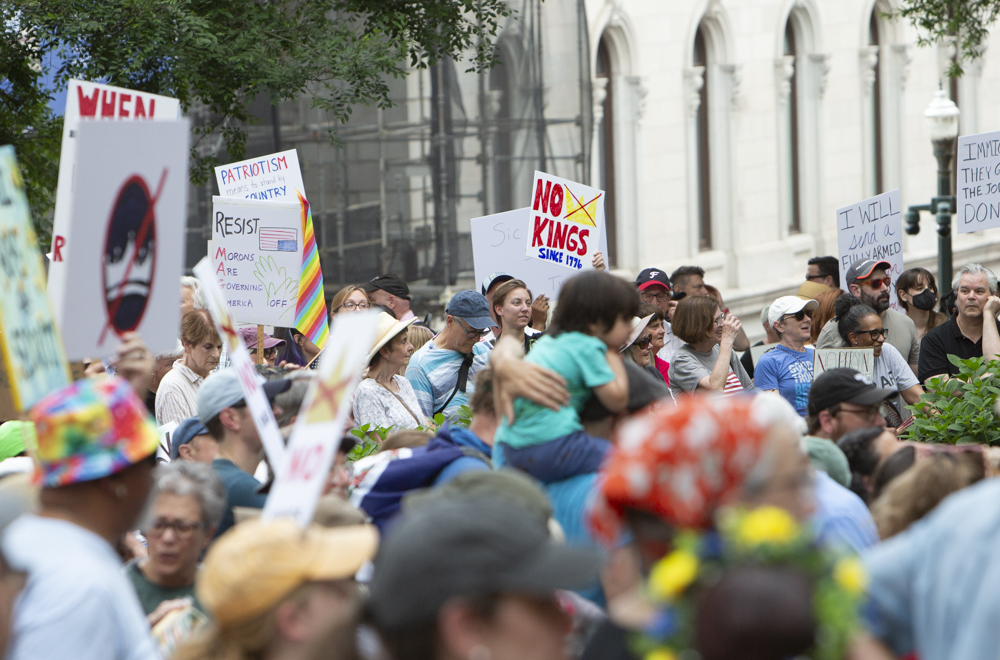
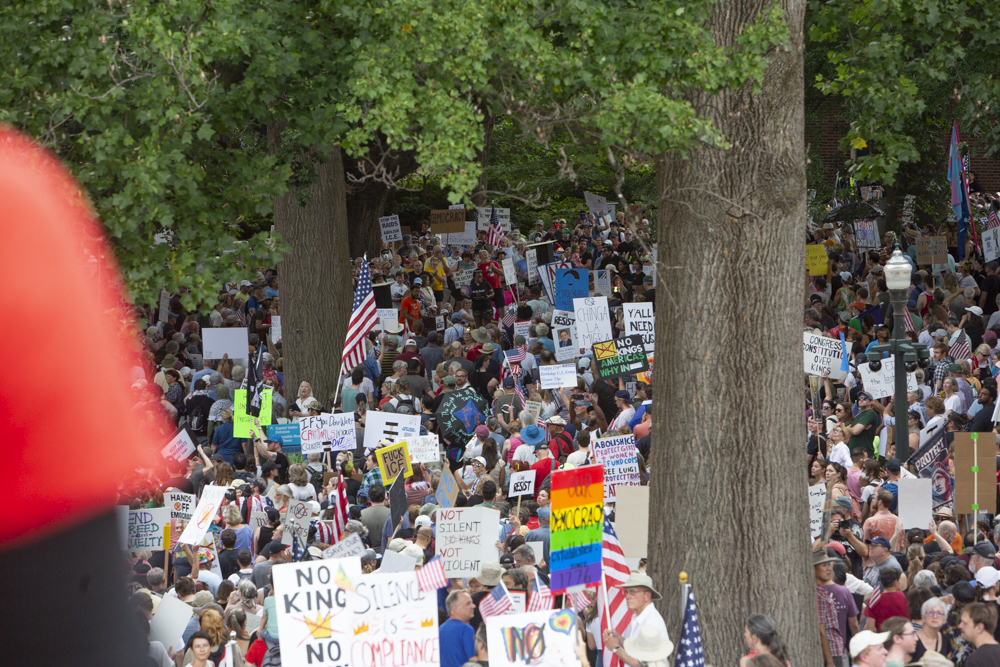
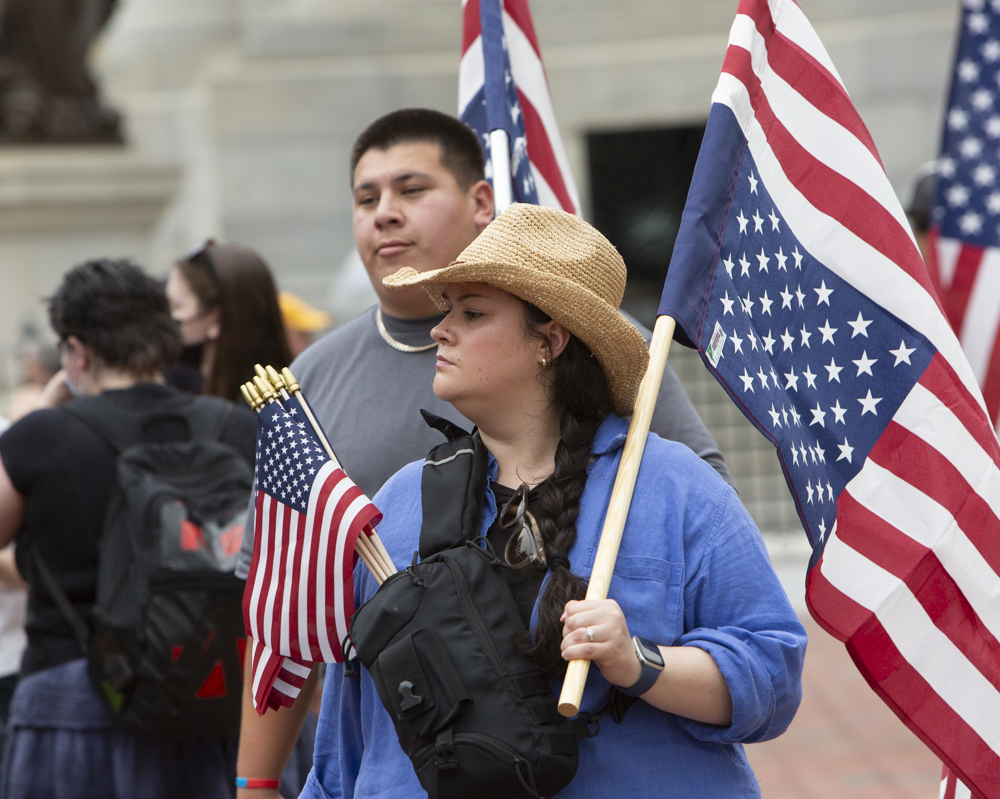
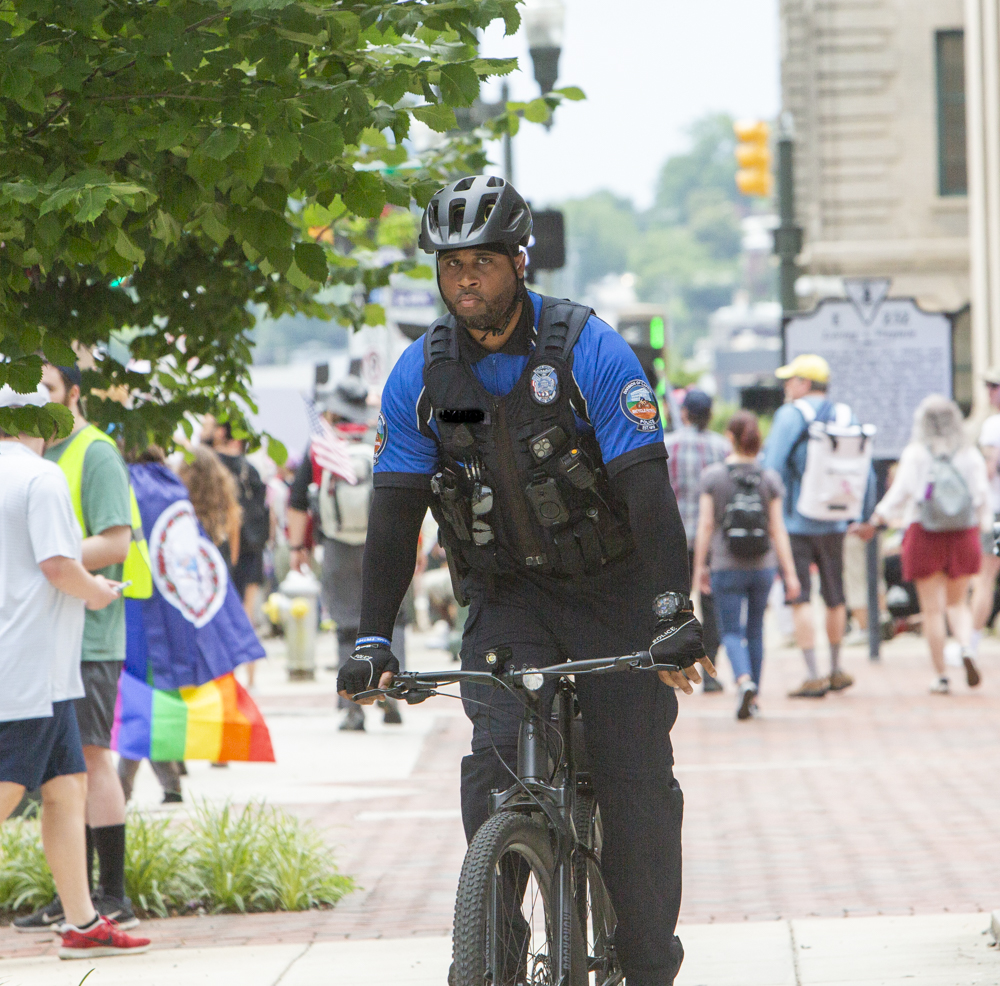
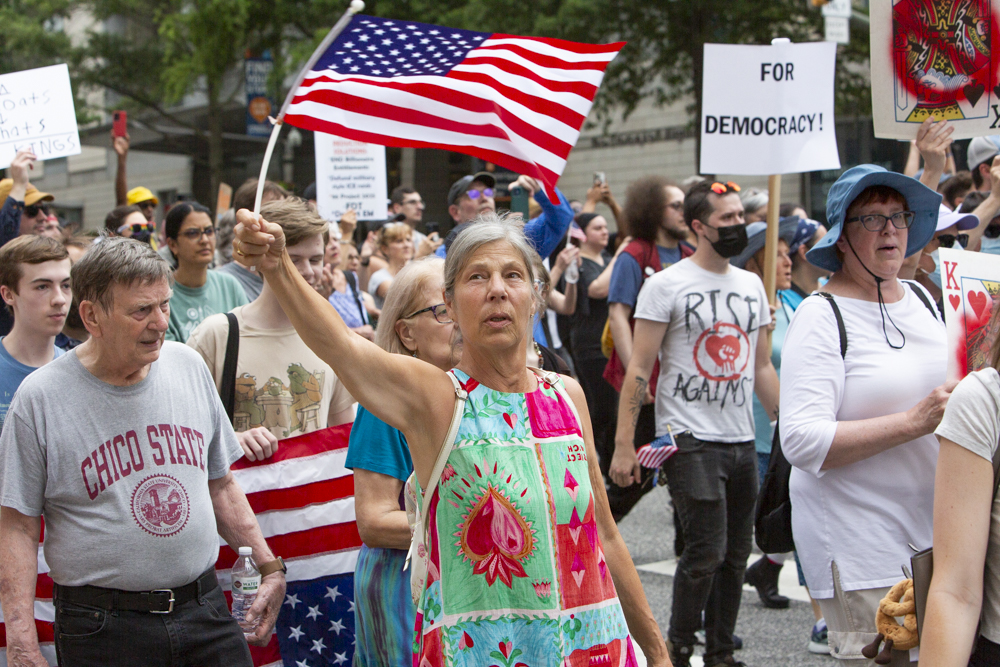
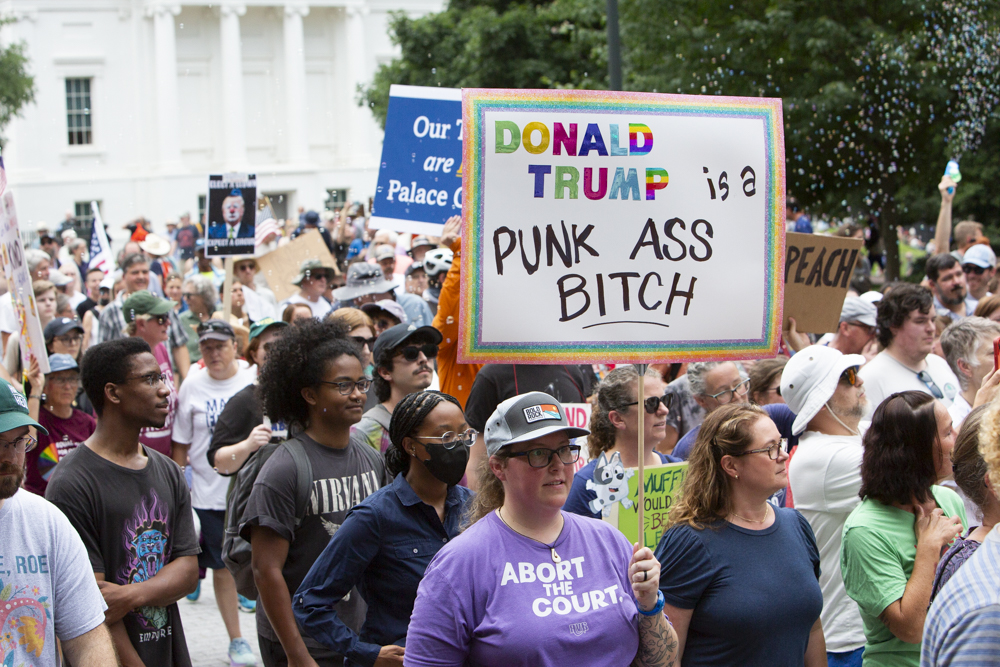
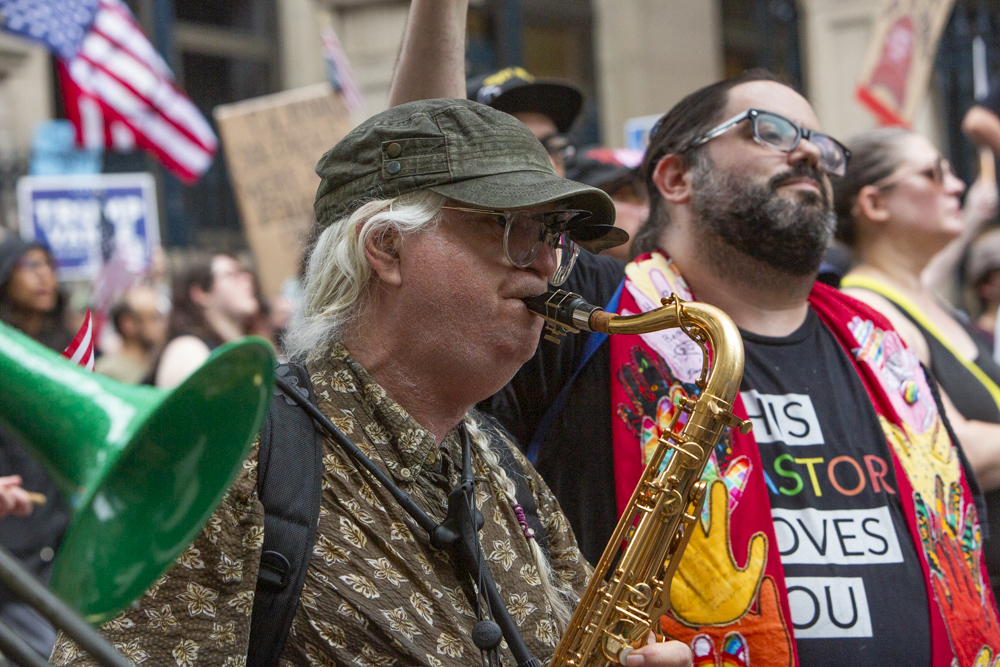
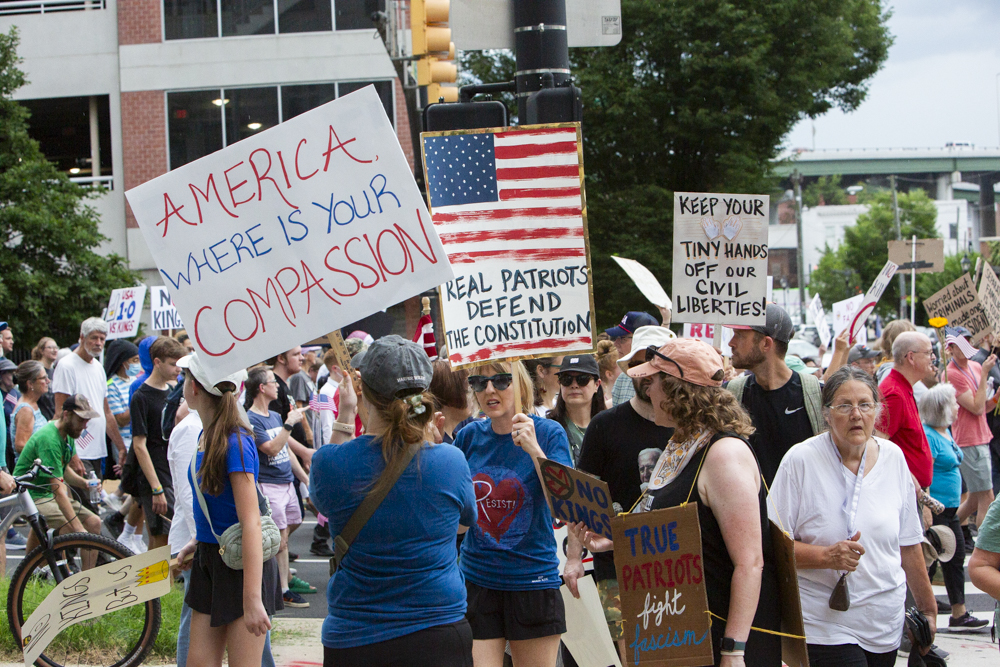
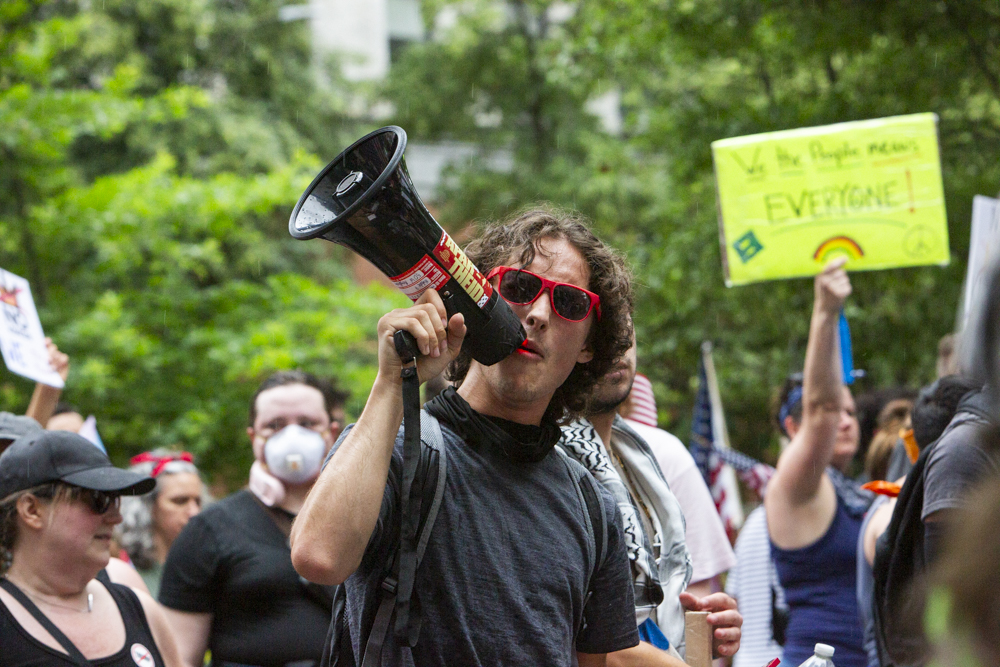
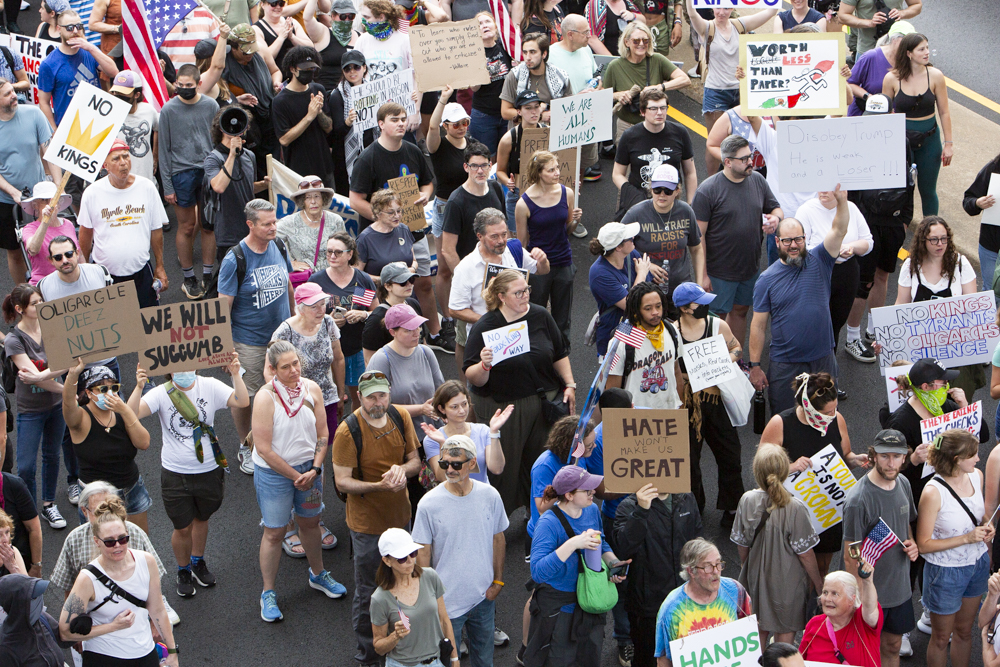
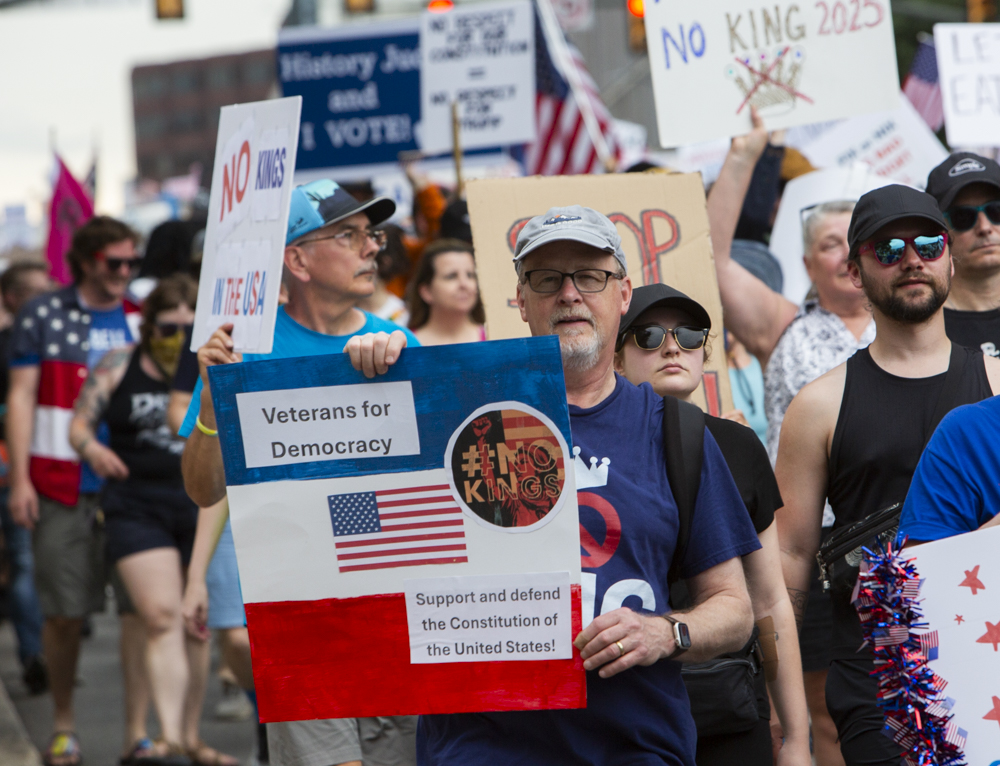
No Kings Protest, Richmond, Virginia, June 14, 2025: A photo journal

Tom’s Report on the State of America’s Democratic Health: Into the Crucible or Just Crazy Bat Shit?

As of June 7, 2025

Benchmarks of Democratic Backsliding and Erosion

Coup 2.0.  Trump continues the January 6 coup attempt.  In an unprecedented memorandum to the U.S. Attorney General, Trump directed the Department of Justice to investigate an alleged criminal conspiracy by former President Biden and his aides to cover up his mental decline.  The memorandum also claims that Biden was not mentally competent to sign legislation into law, appoint federal judges, issue executive orders, etc.  In effect, Trump is attempting to complete the January 6 insurrection and coup, by erasing the Biden Administration.   I suspect the results of the investigation will be used to attempt to discredit and remove all federal judges appointed by Biden, to include Supreme Court Justice Ketanji Brown, and declare all laws signed by Biden are null and void.

In another act of calculated revenge and cruelty, the wrongfully detained and deported man from Maryland, Abrego Garcia, was returned to the U.S. this week from El Salvador, after weeks of delays and claims he couldn’t be repatriated to America.  Garcia was flown to Tennessee where a federal multi-count indictment awaited him.  Nine counts of driving undocumented immigrants across the country and one count of conspiracy.  Garcia is paying the price for Trump’s illegal deportation program being halted by the federal courts.  

On June 4, the White House issued a proclamation targeting citizens of 12 countries from entering the United States.  National security reasons were listed for the travel ban, but they disproportionately targeted African countries, confirming suspicions that Trump is engaged in a campaign to dehumanize and criminalize blackness.

The Department of Defense announced plans to rename the supply ship Harvey Milk.  The renaming is part of a supposed DoD initiate to reinvigorate the military’s warrior spirit.  Milk was a veteran and was assassinated while holding political office.  He was also gay.  Does Hegseth know that one of the most feared ancient Greek fighting units was known as the Sacred Band of Thebes.  It was composed of 300 fighting men, basically 150 partnered lovers.  Also, up for consideration by DoD is to rename ships named after Ruth Bader Ginsberg and anti-slavery warrior and freedom fighter Harriet Tubman.  What is it with Hegseth and Trump and their hatred of powerful women and gay leaders? Anyway, it has long been considered taboo to rename ships. Bring bad luck they say.

The battle between Harvard and Trump continues with the administration issuing a proclamation banning foreign students issued visas to attend Harvard from entering the country.  That ban was halted temporarily by a federal Judge’s injunction on Thursday.  

Meanwhile, the Department of Homeland Security requested that the Defense Department activate 20,000 national guard troops to assist their law enforcement efforts to remove migrants from the country.  The National Guard units would be used for a host of duties, to include helping track down migrants, assignment to detention facilities, transporting migrants, providing other logistical support.  Apparently, in order to skirt Posse Comitatus restrictions, the guard units aren’t being ‘federalized’ so that they can participate in law enforcement operations.  That Act prohibits the military from engaging in law enforcement directly.  Such as making arrests like police officers or directly pursuing suspects. 

In a developing story, Trump activated 2000 California national guardsmen for deployment to Los Angeles following protests and clashes with ICE agents conducting roundups in heavily Latino city districts.  Tensions are high and are exacerbated by self-inflicted stupidity. For instance, earlier in the week in Torrance, a coastal city within the Los Angeles area, a 4th grade boy at his elementary school was detained along with his father.  They were separated at an immigration hearing, sent to Texas, to await deportation to Honduras. 

These provocative actions and others – such as arriving in neighborhoods in military-like uniforms, long guns, body armor, and armored vehicles – are counterproductive and lead to backlashes.  What the hell did they think would happen?  Defense Secretary Hegseth chimed that Marines at a nearby base were on high alert and ready to deploy if needed.  Hegseth, “ARE YOU FUCKING BAT SHIT CRAZY?”  That’s a rhetorical question of course. It seems Trump and his minions are itching to kill Americans in American streets.