Something truly is rotten in Louisa. Recently there have been two eyebrow raising land deals involving current or former board of supervisors or their family members. Below are two examples of intersection of local politics, land deals, and private profit.
The County Landfill:
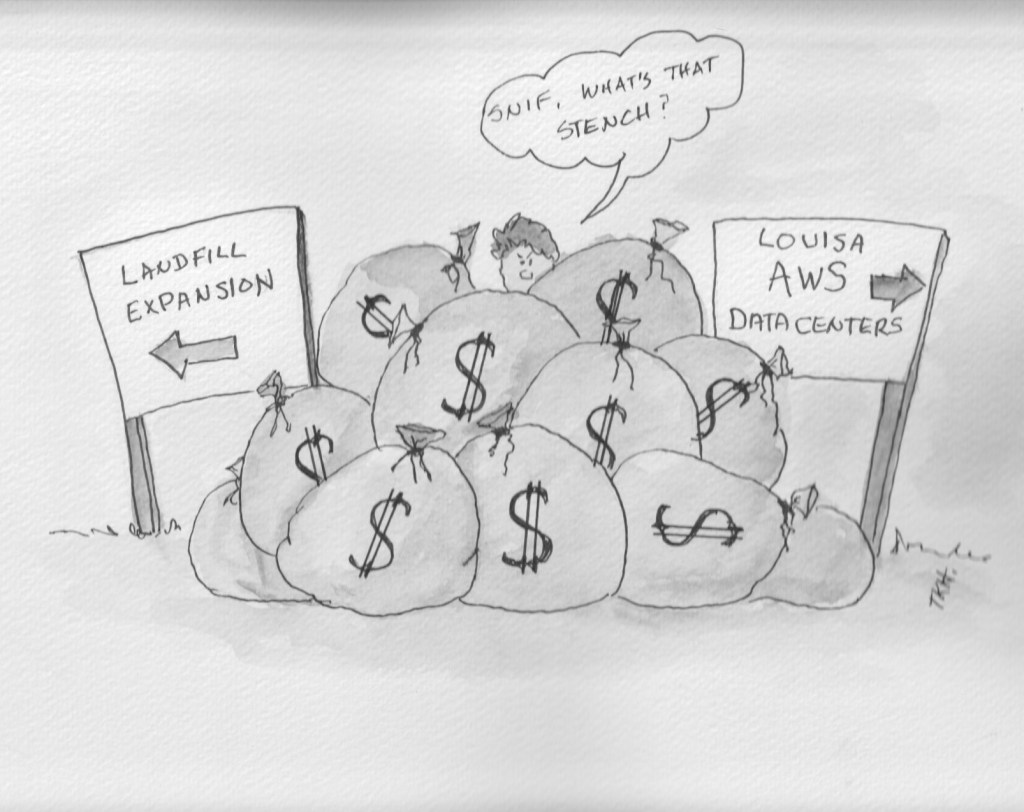
The expansion of the county’s landfill involved the purchase of additional land adjacent to the current landfill. The land, valued from $2000 to $3000 per acre sold for $9000 an acre, according to local reporting.
One of the land owners who benefited from this purchase was a son of one of the county’s Board of Supervisors. The Central Virginian reported in May 2025 that Jackson District Supervisor Williams recused himself from landfill expansion votes because his son Torrey Williams owned some of the adjacent land.
AWS Datacenters and the Fisher Chewing Tract Sale:
A little background, a few years ago the county board of supervisors created a number of technical overlay districts. Basically, a preferred location for technology investment, such as datacenters. The Fisher Chewing tract is located in one of these TODs as folks colloquially call them. Like any gold rush, the board of supervisors had tax revenue gold dust in their eyes and were chasing a pot of gold that does not exist.
As you may recall, the Fisher Chewing tract was going to be the site of a third Amazon datacenter in Louisa. However, because of a local pushback movement and opposition from some board of supervisors, in particular the Mineral District Supervisor Duane Adams, AWS withdrew its’ application for a conditional use permit to build the third datacenter.
I think most folks thought that, ‘well that is that’ a victory for the people. Not so fast. To many a startled resident of Louisa, Amazon Web Services recently purchased 9000 acres for an eye popping $72.45 million. Wait, wait… Part of the land AWS purchased was the 1400 acre Fisher Chewing property. And it gets better. According to the Central Virginian, The Fisher Chewing tract was owned by Fisher Chewing L.C. Now the kicker. Fishers Chewing L.C. is owned by Charles and Eric Purcell. Charles Purcell is a lawyer and developer in Louisa and Eric is a former Louisa District member of the county’s Board of Supervisors.
Now, a curious mind would be asking questions about these land deals. For the latter example, why would AWS buy the Chewing Fisher tract (and other adjacent tracts) for top dollar given that it would basically never be developed as a datacenter site? Doesn’t make sense to me.
The Planning Commission: Pulling back TODs
This week the Louisa Planning Commission meets Thursday at 7 PM at the Louisa Country Office Building, 1 Woolfolk Avenue. On the agenda is an amendment to amend ORD2023 in order to remove the technology overlay district designation encompassing the Fisher Chewing and Cooke Rail tracts of land.
The meeting is open to the public but I don’t know whether there will be a question and answer opportunity.
If you want to follow these developments and others in Louisa County Tammy Purcell’s great substack site called “Engage Louisa” is a super resource: https://tammypurcell.substack.com/
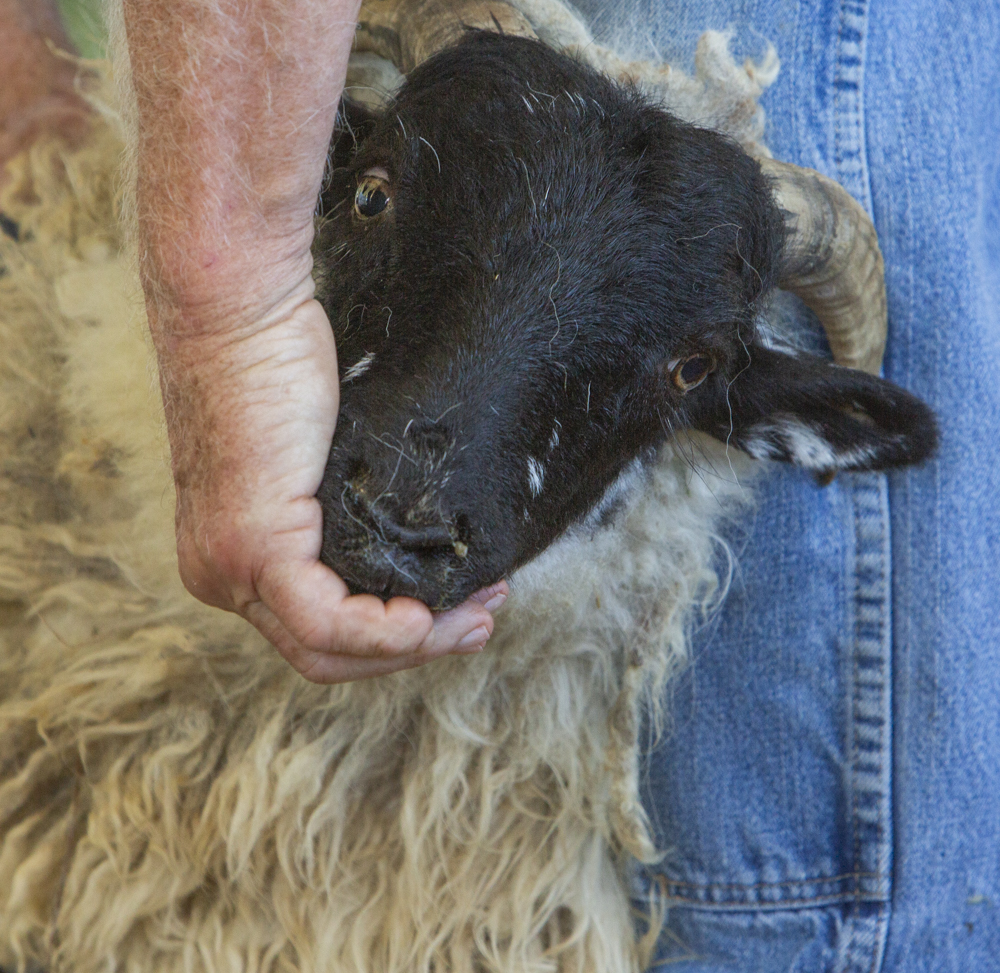
This past Saturday at the Fall Fiber Festival and Montpelier Sheep Dog Trials near Orange, Virginia, something remarkable happened. During the afternoon sheep shearing demonstration, the 70 something farmer from Louisa, teared up when describing how he came to raising sheep and learning how to shear them. He paused, wiping tears from his eyes, sheepishly apologized. He had heart surgery last year, he said. The crowd in the tent was silent, . . . .then a booming gruff, male voice, said, ‘No apology necessary.’ He paused, ‘in fact more people in this country need heart surgery.’ Applause erupted in the crowded tent.
I don’t know the politics of the farmer shearing the sheep, I don’t know the politics of the man comforting the farmer, I don’t know the politics of the crowd, and I certainly don’t know the politics of the sheep. It was a moment of vulnerability, and the response was compassion, a common humanity.
The man with the gruff voice called out the heartlessness of our partisan divide, the hate mongers, the primal chest pounding in some quarters. The farmer then got a 50-pound sheep out of the pen, rassled him into position, and started to shear her with traditional shears. Impressive for anyone, much less a 70-something farmer who recently had heart surgery.
Farming is not for the faint of heart. My wife’s side of the family were Kansas wheat farmers starting in the 1920s. Her mom was one of 12 kids, the first one arriving at 16, the last at 46. Her mom remembers the dust, the jack rabbits, and the wheat. She left when she could. They worked hard, took second jobs to make ends meet. Alas, the farm was sold in the 2003.
Let me snatch your mind back from the precipice of agrarian nostalgia and sentimentality and bring you back to reality.
Americans have long been fascinated by the imagery of a yeoman farmer clearing the fields and tilling the soil. Hard work, independence, self-sufficiency were the supposed hallmarks of America’s rural farmers. American Historian Richard Hofstadter called it the “agrarian myth,” arguing that the “more commercial” America became, “the more reason it found to cling in imagination to the noncommercial agrarian values.” Adding, that “the American mind was raised upon a sentimental attachment to rural living…. The agrarian myth represents a kind of homage that Americans have paid to the fancied innocence of their origins.” Farmers, Hofstadter wrote, are businessmen, first and foremost.
During several past national election seasons, “Farmers For Trump” road signs dotted Louisa County. I always thought the imagery of the word “farmer” was meant to evoke the ‘agrarian myth’ of good honest living, hard work, self-sufficiency, independence and somehow attaching it to a man who has never had a callous from working with his hands, never used a shovel, much less an axe. Who has probably spent more cash on manicures than many farmers have paid for their tractors.
Trump’s policies hurt farmers, to include those in Louisa County. His tariff war, especially his war on Beijing, is bankrupting farmers across the country.
Here are the ground truths.
Virginia’s top agricultural export countries in 2022 were China, Canada, Venezuela (go figure), and Taiwan in that order. Virginia farmers did close to $1.5 billion business with China. Canada came in at a distant second with $370 million. Exports are crashing to these countries because of Trumps policies.
China buys 60 percent of the global supply of soybeans. This year, however, they have bought ZERO soybeans from American farmers. So, 60 percent of the potential Virginia’s and Louisa County’s soybean sales, gone, evaporated, zilch, in the flick of a social media post.
Because of Trump’s tariff war with China, Argentina, Paraguay, and Brazil are now China’s biggest suppliers of soybeans. According to the latest figures I have, Virginia harvested 21.6 million bushels of soybeans in 2023 and that jumped in 2024 to 26.4 million bushels, most destined for export markets, primarily China. This years harvest is at risk of being unsold.
Louisa in 2022 had 8058 acres of soybeans under cultivation. At 44 bushels per acre, that amounts to 354,552 bushels. Assuming that the same number of approximate acres are being grown today, at today’s market value that come out to about $3.6 million. A potential loss of $3.6 million to Louisa farmers if it is left unsold. Net cash income for Virginia and Louisa farmers is dropping because of Trump’s policies.
Crashing commodity prices and massive loss of export buyers is why Trump is promising a farmer bailout. More free cash handouts to loyal farmers. This worked during his first term when Trump bailed out farmers to the tune of billions of dollars because of failed tariff wars. They voted for him again in droves. Why? I don’t know. Makes no sense.
The White House recently proposed a $38 to $50 billion bailout for America’s farmers. That’s about $16k per farmer. I know it won’t be disbursed equally across the board, but it is a bailout for the row crop farmers who are losing export business because of Trump’s shortsighted and counterproductive policies.
In a supreme act of irony, Trump wants to use tariff dollars – basically a consumption tax Americans like you and I pay — to fund the famer bailout. Picking my pocket to give free cash to his farmer voting base. Problem is, Trump can’t just reach into the Treasury and take the money, like a personal piggy bank. He needs Congress to authorize the funds.
Farmers voted for Trump for a variety of reasons, one being they thought he is a good businessman. Well, you got screwed…. again. Time to get beyond the culture wars, hate mongering, and bullshit rhetoric of who is and who is not a real American.
According to government stats analyzed for a 2024 Politico article titled Did Trump or Biden deliver more for farmers? The answer may surprise you, “Biden has been better for farmers than Trump. Net farming income has actually gone up since the Democrat entered the White House. On average, net farm income has totaled $165 billion between 2021 and 2023, compared to $94 billion between 2017 and 2019. Farm income reached a record high of nearly $189 billion in 2022.”
The 2022 Census of Agriculture Louisa County Profile, a U.S. Department of Agriculture publication, supports Politico’s analysis. According to the profile, net cash farm income in Louisa County increased 2269 percent (yes, 2269) between 2017 and 2022. The market value of products sold increased 143 percent over the same period. Mostly, Louisa’s 452 farmers did well under Biden, but many threw away these Biden gains made after Trump’s first term mistakes, exacerbated by Trump’s thoroughly horrible mismanagement of the pandemic response, by helping to elect Trump to a second term. 100 days into his second term Trump later needs to bailout farmers once again. Enough, no?
I think I made a good economic case that voting for Trump is bad for business. Like sheep, he is herding farmers in order to fleece them. He isn’t much better in most measures regarding democracy and rule of law as well. Please vote for Abigail Spanberger for Governor this November, and in the mid-terms in 2026, help throw out 5th District representative John McGuire so Congress can do its constitutional duty to reign in Trump’s dash toward autocracy and bankrupting America’s farmers. A vote for Democrats is a vote to return to prosperity.
On a hot and steamy summer evening, Louisa residents gathered at the High School theater to participate in a town hall meeting organized by Mineral Supervisor, and Chairman of the Louisa Board of Supervisors, Duane Adams. I estimate approximately 300 folks attended, representing not only the Mineral district but a broad representation of the whole of Louisa County. The mood light, but pensive, as folks entered and took their seats or milled about chatting with one another.
After brief remarks by Adams, the question session began. From the first question onward, it was clear that the majority opposed the proposed Fisher Chewing Data Center Campus. Questions focused on three main themes: water, power, and projected tax revenues. Skepticism abounded. The questions were not limited to the proposed new data center campus, however, but also focused on the two already approved Amazon Web Service data centers and the newly announced Shannon Hill Road data center near I-64.
In one early exchange, a woman who said she worked professionally as a data center designer and planner, challenged Adams’s assertion that every five years the data center’s hardware, such as servers, would be replaced. By installing new equipment every five years, Adams’s alleged, the business tax revenues would reset, with Louisa County reaping the maximum tax revenue. She said that assumption was flat out wrong.
She has a point, Loudoun County had a $60 million dollar tax shortfall based on this very same faulty assumption regarding a five year replacement cycle. Data centers can depreciate their hardware/equipment which allows them to pay less taxes as the equipment ages. They do not have some magical 5 year replacement cycle and replacement depends on a whole host of complex business reasons, corporate profit being one of them. This holds true for data centers in Louisa.
Adams seemed taken aback, and when she then asked Adams if the proposed data center was going to be a tier 1, 2, 3, or 4 facility, he looked a deer in the headlights, and did not answer, at least not coherently, and continued to talk over her, refusing to let her respond to his remarks, quickly moving on to another questioner. Many in the crowd were not happy with Adam’s silencing tactic, and shouted for her to be able to respond, “let her respond” rang out for a minute or so. She was never permitted to ask another question during the town hall, even though she was promised an opportunity ‘once everyone else had asked their questions.’
Adams talking over women questioners and not letting them finish their questions was a theme throughout the evening, but perhaps that is a topic of another essay.
Nonetheless, this did not deter others from asking pointed questions about noise pollution abatement; carbon offsets, water sources and usage; sewage treatment for contaminated cooling water; fallacies in the tax revenue projections; why a billion dollar corporation needs tax waivers that normal Louisa business do not get (for instance their tax rate on business equipment); number of jobs once construction is over (which Adams wildly over inflated); sources and cost of power (which Adams routinely demurred with the response that power “was not in our control”).
The town hall lasted just short of two hours, with a majority of those wanting to ask questions denied the opportunity to do so were left with the option to submit their questions on a form. In the end, Adams said he would not vote to approve the data center. Adams, from the start of the town hall, said that he was not enthralled by the proposal, but despite that assertion, he seemed overly defensive throughout the question session. One can read from his behavior that perhaps he wasn’t being totally forthright about his doubts about the proposal or was defensive about previous decisions regarding data centers he had made. Nonetheless, he continued, cautioning that he was one of six supervisors, and that folks need to reach out to their respective district supervisors.
Overall, the town hall was an opportunity for the community to speak its collective mind about not only the newly proposed data center, but about data centers in general in Louisa County and their unknown impacts, large and small. Near the end you heard more and more the question, “Why the rush? Why the rush?” I get the sense that folks just want to wait and see the impacts of the first two data centers and not blindly rush into new agreements and contracts, chasing the siren calls of easy tax revenue.